As most readers will already know, a new 0-day vulnerability in MS Video ActiveX Control is currently being exploited in the wild. Lots of research material has already been published covering different aspects of this vulnerability and the attack vector. I have nothing more to add on this front. I would rather focus on explaining the details of the malware behind the scenes.

-
FireEye Platform
-
White Paper
Protecting Your Data, Intellectual Property, and Brand from Cyber Attacks

Guide for CIOs, CFOs, and CISOs on why traditional security defenses are failing and how losing the security battle can hurt your business
-
Products & Solutions
-
- Threat Prevention Platforms
- Network Security (NX Series)
- Email Security (EX Series)
- Content Security (FX Series)
- Endpoint Security (HX Series)
- Cloud-Based Platforms
- Email Threat Prevention
- Mobile Threat Prevention
- Threat Analytics Platform
- Subscriptions and Management
- Managed Defense
- Central Management (CM Series)
- Dynamic Threat Intelligence (DTI)
-
- Solutions
- Data Center
- Small and Midsize Businesses
- Industry Solutions
- Government
- Pharmaceutical
- Retail
- Services
- Mandiant Services
- Resources
- Visio Stencils
-
Webcast
Product Demo

Inside look at stopping zero-day attacks and advanced persistent threats with FireEye
-
-
Info Center
-
White Paper
Advanced Targeted Attacks

Look into the changing nature of today's advanced targeted attacks and why traditional IT security is inadequate
-
Partners
-
- Partner Login Required
- Partner Enablement - The Fuel Station
- Partner Portal
- Education Center
-
White Paper
Spear Phishing Attacks

Deep dive into spear phishing attacks and what is needed to combat this type of advanced threat
-
News & Events
-
Video
The New Threat Landscape

Insight into how FireEye is able to combat even the most sophisticated threats
-
Company
-
Brochure
FireEye Corporate Overview

Overview of the FireEye product family which protects against advanced cyber attacks
Blog
Information and insight on today's advanced threats from the leader in advanced threat prevention.
All Posts
Web2SMS Gateways, A Wide Open Target
The number of mobile payment users worldwide will total 73.4 million in 2009, up 70.4 percent from 2008 when there were 43.1 million users.
Gartner, Inc.
Keeping in mind the above stats, it's pretty clear that these millions of mobile payment user's are an ideal target for mobile spam. Spam emails have already polluted the Internet experience for millions of PC users. Here by mobile spam I don't mean the smaller number of cellular phones connected to the Internet using expensive GPRS or 3G networks receiving email messages (including spam) just like a normal PC via POP3, HTTP or IMAP etc. Instead I am talking about the millions of those cellular phones which are capable of receiving/sending simple text messages using Short Message Service communication (SMS). How can these spammers send spam to these millions of mobile users?
SPAM bots have bugs too!
As you may or may not know, the popular SPAM bots work off something called a "template". These templates contain tokens for the system-resident malware to replace with a word list that is periodically fetched from an external server. In the past we've seen some bots that clearly separate the template update mechanism from the c&c communication (like Pushdo/Cutwail) and some that combine it more into one blurry malware package (like Rustock or Grum).
What’s behind the “Nine Ball” attacks?
It all started when reports started to come from WebSense that more than 40,000 legitimate web sites had been compromised by a new wave of attacks being dubbed as 'Nine Ball'. Initial reports did not have enough details to help identify the malware behind these attacks. Luckily soon after, Andrew Martin came up with a very good write up about the malware behind the scenes. My article is an extension of Martin's initial analysis. I'll try to concentrate on aspects of this malware not already covered. From Andrew's analysis, I was able to find the md5 of the parent malware (the one which is dropped by web exploit(s)). It was enough to give me a good starting point.
Killing the beast…Part 2
In this second part of the series I will try to analyze the command and control structure/coordinates for another famous botnet, Koobface. This article is not a detailed analysis of the malware itself but covers mostly its botnet aspect. Readers who are interested to learn about the internals of this malware may refer these articles:
Koobface Leaves Victims the Black Spot
These articles were published back in December 2008 but most of the details are still valid for the newer versions.
Back to the CnC structure … Koobface relies mostly on domain names to locate its CnC servers, instead of using hard coded IPs like Pushdo. As a matter of fact, I observed that it tends to change its CnC domains more often than the IPs behind those domains. Based on my lab data (for the last 3 months or so) I see Koobface connecting to 23 unique domains.
Here is the complete list:
Killing the beast…Part 1
The purpose of this series of articles is very simple, to give our readers an idea about the current geographical distribution of command and control coordinates for the some of the top botnets. Based on this data I'll try to estimate whether it is possible to shutdown these botnets by puling the plug for these servers. The Botnets which will be discussed in these articles are Pushdo, Xarvester, Rustock, Koobface and Ozdok. These stats are based on my sandnet logs for the last 3 months or so. By no means is this list complete but it will give our reader a reasonable idea about the current motherships for these botnets.
Pushdo
Here is the list of Pushdo CnCs arranged in tabular form:
Cryptanalysis of VSCrypt
Ransomware and the Control Sum Cript Algorithm v1.0
Introduction
I was recently sent an email by someone who was hit with a new species of ransomware. This one encrypted all of the documents on the system, attached the extension .vscrypt
to the end, and changed the desktop wallpaper to a ransom note written in Russian. Here are my findings…
Yet another SPAM Bot
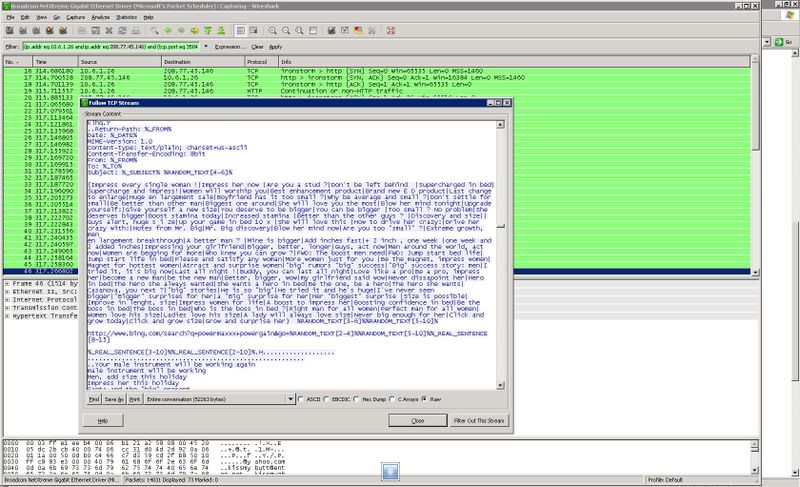
Today while I was casually going through my sandnet logs, one malware outbound communication suddenly caught my attention. This communication certainly looked like a SPAM template download. Unlike other famous botnets like Cutwail, Rustock, Tofsee, Srizbi, Xarvester, etc, the spam template was in plain text and all the artifacts were clearly visible.
Ransom - Pay me more - Part 2
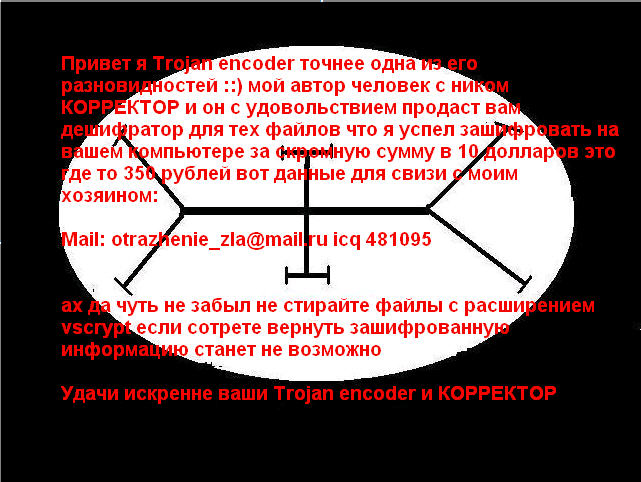
I recently got an important clue how the ransom exchange takes place between a victim and cyber criminals. One of readers who became a victim of this ransomware dropped an email to the author at the address otrazhenie_zla@mail.ru for his files to be recovered. This was the response by the author:
"Transfer into account pay pal 50 dollars here email pay pal otrazhenie_zla@mail.ru'
Interestingly, instead of asking him for the standard $10 ransom (as mentioned in his earlier message) he asked him for $50 - typical criminal mentality, isn't it? Unfortunately his greed doesn't end here. This malware instance came bundled in a fake 'SWF video codec' file. Upon execution, this setup file installs three different pieces of malware on the victim machine including this ransomware.
Ransom - Pay me more!
Continuing the legacy of GPcode and FileFixer , a new file encoder trojan (5f9927ee59b4881a2ce8634332f63fa8) is on the loose. Upon execution, this malware looks for user's data files (ending with .jpg, .zip, .doc , and .text etc) on the system drives and encrypts them.
For example a user's file having name 'mic.jpg' will be replaced by 'mic.jpg.vscrypt'. After finishing encrypting user data files this malware will change desktop image with its own version and simply quit after restarting the user's machine. It doesn't attempt to install itself on the user's system permanently.
Here is a sample encrypted Download Sunset.jpg file. The message which is left behind for victim on desktop looks like this:
Threat Research
Filter by Category:
Black Hat USA Talks: Investigating PowerShell Attacks
Threat actors are always eager to adopt new tools, tactics, and procedures that can help them evade detection and conduct their mission. Incident responders from Mandiant have observed increasing use of PowerShell by targeted attackers to conduct command-and-control in compromised Windows networks. As a trusted administration tool built-in to all modern versions of Windows, PowerShell provides the ability to access remote systems, execute commands, transfer files, load malicious code, and interact with underlying components of the operating system – all tasks for which attackers must otherwise rely on malware. This has created a whole new playground of intrusion techniques for intruders that have already established a foothold on systems in a corporate network.
Ryan Kazanciyan and Matt Hastings will talk about the use of PowerShell throughout the attack lifecycle and the sources of evidence it leaves behind in memory, on disk, in logs, and elsewhere. They will demonstrate how to collect and interpret these forensic artifacts, both on individual systems and at scale. Throughout the presentation, they will include examples from real-world incidents.
Attend this presentation on August 7 at 4:05pm PT in South Seas GH. Make sure to use #BHUSA and @FireEye if you plan to tweet highlights from the talk.
To view the whitepaper, click here.
Black Hat USA Talks: Sidewinder Targeted Attack Against Android in The Golden Age of Ad Libs
While Google Play has little malware, many vulnerabilities exist in the apps as well as the Android system itself, and aggressive ad libs leak a lot of user privacy information. When they are combined together, more powerful targeted attacks can be conducted.
In this presentation, FireEye’s Yulong Zhang and Tao Wei will present one practical case of such attacks called “Sidewinder Targeted Attack.” It targets victims by intercepting location information reported from ad libs, which can be used to locate targeted areas such as a CEO’s office or some specific conference rooms. When the target is identified, “Sidewinder Targeted Attack” exploits popular vulnerabilities in ad libs, such as Javascript-binding-over-HTTP or dynamic-loading-over-HTTP, etc.
During the exploit, it is a well-known challenge to call Android services from injected native code due to the lack of Android application context. So they will also demonstrate how attackers can invoke Android services such as taking photos, calling phone numbers, sending SMS, reading/writing the clipboard, etc. Once intruding into the target, the attackers can exploit several Android vulnerabilities to get valuable privacy information or initiate more advanced attacks. We will reveal how to exploit new vulnerabilities we discovered in this phase.
In addition, they will show demos using real-world apps downloaded from Google Play.
Although they notified Google, ad vendors and app developers about related issues half a year ago, there are still millions of users under the threat of “Sidewinder Targeted Attacks” due to the slow patching/upgrading/fragmentation of the Android ecosystem.
Attend this presentation on August 7 at 10:15am PT in South Seas GH. Make sure to use #BHUSA and @FireEye if you plan to tweet highlights from the talk.
To view the whitepaper, click here.
Black Hat USA Talks - Leviathan: Command And Control Communications On Planet Earth
Every day, computer network attackers leverage a Leviathan of compromised infrastructure, based in every corner of the globe, to play hide-and-seek with network security, law enforcement, and counterintelligence personnel.
This presentation draws a new map of Planet Earth, based not on traditional parameters, but on hacker command and control (C2) communications. The primary data points used in this worldwide cyber survey are more than 30 million malware callbacks to over 200 countries and territories over an 18-month period, from January 2013 to June 2014.
First, this talk covers the techniques that hackers use to communicate with compromised infrastructure across the globe. The authors analyze the domains, protocols, ports, and websites used for malicious C2. They explain how covert C2 works, and how attackers keep their communications hidden from network security personnel.
Second, this talk looks at strategic impact. The authors examine relationships between the targeted industries and countries and the first-stage malware servers communicating with them. Traffic analysis is used to deduce important relationships, patterns, and trends in the data. This section correlates C2 communications to traditional geopolitical conflicts and considers whether computer network activity can be used to predict real world events.
In conclusion, the authors consider the future of this Leviathan, including whether governments can subdue it – and whether they would even want to.
Attend this presentation on August 7 at 10:15am PT in South Seas GH. Make sure to use #BHUSA and @FireEye if you plan to tweet highlights from the talk.
To view the whitepaper, click here.
Operation Poisoned Hurricane
Introduction
Our worldwide sensor network provides researchers at FireEye Labs with unique opportunities to detect innovative tactics employed by malicious actors and protects our clients from these tactics. We recently uncovered a coordinated campaign targeting Internet infrastructure providers, a media organization, a financial services company, and an Asian government organization. The actor responsible for this campaign utilized legitimate digital certificates to sign their tools and employed innovative techniques to cloak their command and control traffic.
Hurricane Electric Redirection
In March of 2014, we detected Kaba (aka PlugX or SOGU) callback traffic to legitimate domains and IP addresses. Our initial conclusion was that this traffic was the result of malicious actors ‘sleeping’ their implants, by pointing their command and control domains at legitimate IP addresses. As this is a popular technique, we did not think much of this traffic at the time.
Further analysis revealed that the HTTP headers of the traffic in question contained a Host: entry for legitimate domains. As we have previously observed malware families that forge their HTTP headers to include legitimate domains in callback traffic, we concluded that the malware in this case was configured in the same way.
An example of the observed traffic is as follows:
POST /C542BB084F927229348B2A34 HTTP/1.1

Accept: */*

CG100: 0

CG103: 0

CG107: 61456

CG108: 1

User-Agent: Mozilla/4.0 (compatible; MSIE 9.0; Windows NT 6.1; SLCC2; .NET CLR 2.0.50727; .NET CLR 3.5.30729; .NET CLR 3.0.30729; Media Center PC 6.0; .NET4.0C)

Host: www.adobe.com

Content-Length: 0

Cache-Control: no-cache
As we continued to see this odd traffic throughout the summer we began a search for malware samples responsible for this behavior. Via this research, we found a malware sample that we believe was responsible for at least some of the strange traffic that we had observed. The identified sample had the following properties:
MD5: 52d2d1ab9b84303a585fb81e927b9e01

Size: 180296

Compile Time: 2013-10-15 05:17:37

Import Hash: b29eb78c7ec3f0e89bdd79e3f027c029

.rdata: d7b6e412ba892e9751f845432625bbb0

.text: ed0dd6825e3536d878f39009a7777edc

.data: 1bc25d2f0f3123bedea254ea7446dd50

.rsrc: 91484aa628cc64dc8eba867a8493c859

.reloc: f1df8fa77b5abb94563d5d97e5ccb8e2

RT_VERSION: 9dd9b7c184069135c23560f8fbaa829adc7af6d2047cf5742b5a1e7c5c923cb9
This sample was signed with a legitimate digital certificate from the ‘Police Mutual Aid Association’. This certificate has a serial number of ‘06 55 69 a3 e2 61 40 91 28 a4 0a ff a9 0d 6d 10’.
Analysis of this Kaba sample revealed that it was configured to directly connect to both www.adobe.com and update.adobe.com. Obviously, this configuration does not make a lot of sense, as the actor would not be able to control their implants from anywhere on the Internet since they did not have direct control over these domains – unless the attackers were able to re-route traffic destined for these domains from specific victims. Indeed, further analysis of this Kaba variant revealed that it was also configured to use specific DNS resolvers. This sample was configured to resolve DNS lookups via Hurricane Electric’s nameservers of 216.218.130.2, 216.218.131.2, 216.218.132.2 and 216.66.1.2.
We found this interesting, so we investigated how these Hurricane Electric’s nameservers were configured. Subsequently, we found that anyone could register for a free account with Hurricane Electric’s hosted DNS service. Via this service, anyone with an account was able to register a zone and create A records for the registered zone and point those A records to any IP address they so desired. The dangerous aspect of this service is that anyone was able to hijack legitimate domains such as adobe.com. Although these nameservers are not recursors and were not designed to be queried directly by end users, they were returning results if queried directly for domains that were configured via Hurricane Electrics public DNS service. Furthermore, Hurricane Electric did not check if zones created by their users were already been registered or are otherwise legitimately owned by other parties.
As we continued this research, we identified 21 legitimate fully qualified domain names that had been hijacked via this technique by at least one APT actor. In addition to the adobe.com domain mentioned above, another one of the poisoned domains is www.outlook.com. A lookup of this domain via Google’s DNS resolvers returns expected results:
$ dig +short @8.8.8.8 www.outlook.com

www.outlook.com.glbdns2.microsoft.com.

www-nameast.outlook.com.

157.56.240.246

157.56.236.102

157.56.240.214

157.56.241.102

157.56.232.182

157.56.241.118

157.56.240.22
A quick lookup of these addresses reveal that Microsoft owns them:
157.56.240.246 | 8075 | 157.56.0.0/16 | MICROSOFT-CORP-MSN-A | US | MICROSOFT.COM | MICROSOFT CORPORATION

157.56.236.102 | 8075 | 157.56.0.0/16 | MICROSOFT-CORP-MSN-A | US | MICROSOFT.COM | MICROSOFT CORPORATION

157.56.240.214 | 8075 | 157.56.0.0/16 | MICROSOFT-CORP-MSN-A | US | MICROSOFT.COM | MICROSOFT CORPORATION

157.56.241.102 | 8075 | 157.56.0.0/16 | MICROSOFT-CORP-MSN-A | US | MICROSOFT.COM | MICROSOFT CORPORATION

157.56.232.182 | 8075 | 157.56.0.0/16 | MICROSOFT-CORP-MSN-A | US | MICROSOFT.COM | MICROSOFT CORPORATION

157.56.241.118 | 8075 | 157.56.0.0/16 | MICROSOFT-CORP-MSN-A | US | MICROSOFT.COM | MICROSOFT CORPORATION

157.56.240.22 | 8075 | 157.56.0.0/16 | MICROSOFT-CORP-MSN-A | US | MICROSOFT.COM | MICROSOFT CORPORATION
However, as recently as August 4, 2014 a lookup of the same www.outlook.com domain via Hurricane Electric’s resolvers returned entirely different results[1]:
$ dig +short @216.218.130.2 www.outlook.com

59.125.42.167
$ dig +short @216.218.131.2 www.outlook.com
59.125.42.167
$ dig +short @216.218.132.2 www.outlook.com
59.125.42.167
$ dig +short @216.66.1.2 www.outlook.com
59.125.42.167
$ whois -h asn.shadowserver.org ‘origin 59.125.42.167′
3462 | 59.125.0.0/17 | HINET | TW | HINET.NET | DATA COMMUNICATION BUSINESS GROUP
Passive DNS research on the 59.125.42.167 IP address revealed that multiple APT actors have previously used this IP address.
| IP Address | Domain | First Seen | Last Seen |
| 59.125.42.167 | ml65556.gicp[.]net | 2014-06-23 | 2014-07-23 |
| 59.125.42.167 | wf.edsplan[.]com | 2014-05-12 | 2014-05-14 |
| 59.125.42.167 | gl.edsplan[.]com | 2014-05-12 | 2014-05-14 |
| 59.125.42.167 | unix.edsplan[.]com | 2014-05-12 | 2014-05-14 |
Additional researched uncovered more Kaba samples that were configured to leverage Hurricane Electric’s public DNS resolvers. Another sample has the following properties:
MD5: eae0391e92a913e757ac78b14a6f079f

Size: 184304

Compile Time: 2013-11-26 17:39:25

Import Hash: f749528b1db6fe5aee61970813c7bc18

Text Entry: 558bec83ec1056ff7508ff1518b00010

.rdata: 747abda5b3cd3494f056ab4345a909e4

.text: 475c20b8abc972710941ad6659492047

.data: d461f8f7b3f35b7c6855add6ae59e806

.rsrc: b195f57cb5e605cb719469492d9fe717

.reloc: d6b23cb71f214d33e56cf8f6a10c0c10

RT_VERSION: 9dd9b7c184069135c23560f8fbaa829adc7af6d2047cf5742b5a1e7c5c923cb9
This sample is signed with a recently expired digital certificate from ‘MOCOMSYS INC’. This certificate has a serial number of ‘03 e5 a0 10 b0 5c 92 87 f8 23 c2 58 5f 54 7b 80’.
This sample used Hurricane Electric’s public DNS resolvers to route traffic to the hijacked domains of www.adobe.com and update.adobe.com. We also noted that this sample was configured to connect directly to 59.125.42.168 – one IP address away from the IP that received traffic from the hijacked www.outlook.com domain.
Passive DNS research revealed that this IP hosted the same set of known APT domains listed above:
| IP Address | Domain | First Seen | Last Seen |
| 59.125.42.168 | ml65556.gicp[.]net | 2014-04-23 | 2014-07-24 |
| 59.125.42.168 | wf.edsplan[.]com | 2014-04-23 | 2014-05-14 |
| 59.125.42.168 | gl.edsplan[.]com | 2014-05-04 | 2014-05-14 |
| 59.125.42.168 | unix.edsplan[.]com | 2014-05-04 | 2014-05-14 |
While this problem does not directly impact users of www.adobe.com, www.outlook.com, or users of the other affected domains, it should not be dismissed as inconsequential. Actors that adopt this tactic and obfuscate the destination of their traffic through localized DNS hijacks can significantly complicate the job of network defenders.
Via our sensor network, we observed the actor responsible for this activity conducting a focused campaign. We observed this actor target:
- Multiple Internet Infrastructure Service Providers in Asia and the United States
- A Media Organization based in the United States
- A financial institution based in Asia
- An Asian government organization
Google Code Command and Control
Furthermore, we also discovered this same actor conducting a parallel campaign that leveraged Google Code for command and control. On August 1, 2014 we observed a malicious self-extracting executable (aka sfxrar) file downloaded from 211.125.81.203. This file had the following properties:
MD5: 17bc9d2a640da75db6cbb66e5898feb1

Size: 282800 bytes
A valid certificate from ‘QTI INTERNATIONAL INC’ was used to sign this sfxrar. This certificate had a serial number of ‘2e df b9 fd cf a0 0c cb 5a b0 09 ee 3a db 97 b9’. The sfxrar contained the following files:
| File | Size | MD5 |
| msi.dll | 11680 | 029c8f56dd89ceeaf928c3148d13eba7 |
| msi.dll.dat | 115218 | 62834d2c967003ba5284663b61ac85b5 |
| setup.exe | 34424 | d00b3169f45e74bb22a1cd684341b14a |
Setup.exe is a legitimate executable from Kaspersky used to load the Kaba (aka PlugX) files – msi.dll and msi.dll.dat.

These Kaba files are configured to connect to Google Code – specifically code.google.com/p/udom/. On August 1, this Google Code project contained the encoded command “DZKSGAAALLBACDCDCDOCBDCDCDOCCDADIDOCBDADDZJS”.
def NewPlugx_C2_redir_decode(s):
rvalue = “”
for x in range(0, len(s), 2):
tmp0 = (ord(s[x+1]) - 0×41) << 4
rvalue += chr(ord(s[x]) + tmp0 - 0×41)
return rvalue
The command ‘DZKSGAAALLBACDCDCDOCBDCDCDOCCDADIDOCBDADDZJS’ decodes to 222.122.208.10. In a live environment, the Kaba implant would then connect to this IP address via UDP.
Further analysis of project at code.google.com/p/udom/ revealed the project owner, 0x916ftb691u, created a number of other projects. We decoded the commands hosted at these linked projects and found that they issued the following decoded commands:
112.175.143.22
59.125.42.167
153.121.57.213
61.82.71.10
202.181.133.169
61.78.32.139
61.78.32.148
202.181.133.216
59.125.42.168
119.205.217.104
222.122.208.10
112.175.143.16
222.122.208.9
27.122.13.204
It is likely that other yet to be discovered Kaba variants are configured to connect to these related Google Code projects and then redirect to this list of IP addresses.
Passive DNS analysis of these IP addresses revealed connections to the following known malicious infrastructure:
| IP Address | Domain | First Seen | Last Seen |
| 27.122.13.204 | bq.cppcp[.]com | 2014-03-21 | 2014-05-08 |
| 112.175.143.16 | uj.verisignss[.]com | 2013-06-30 | 2013-08-13 |
| 112.175.143.16 | www.verifyss[.]com | 2013-06-30 | 2013-07-22 |
| 112.175.143.16 | uj.byonds[.]com | 2013-06-24 | 2013-07-22 |
| 112.175.143.16 | uj.verifyss[.]com | 2013-06-30 | 2013-07-22 |
| 59.125.42.168 | ml65556.gicp[.]net | 2014-04-23 | 2014-07-24 |
| 59.125.42.168 | wf.edsplan[.]com | 2014-04-23 | 2014-05-14 |
| 59.125.42.168 | gl.edsplan[.]com | 2014-05-04 | 2014-05-14 |
| 59.125.42.168 | unix.edsplan[.]com | 2014-05-04 | 2014-05-14 |
| 59.125.42.167 | ml65556.gicp[.]net | 2014-06-23 | 2014-07-23 |
| 59.125.42.167 | wf.edsplan[.]com | 2014-05-12 | 2014-05-14 |
| 59.125.42.167 | gl.edsplan[.]com | 2014-05-12 | 2014-05-14 |
| 59.125.42.167 | unix.edsplan[.]com | 2014-05-12 | 2014-05-14 |
| 61.78.32.148 | door.nexoncorp[.]com | 2014-04-30 | 2014-06-22 |
| 61.78.32.148 | verisignss[.]com | 2014-04-30 | 2014-06-22 |
| 61.78.32.148 | th.nexoncorp[.]com | 2014-04-30 | 2014-06-22 |
| 61.78.32.148 | tw.verisignss[.]com | 2014-04-30 | 2014-06-22 |
| 61.78.32.148 | sd.nexoncorp[.]com | 2014-04-30 | 2014-06-22 |
| 61.78.32.148 | mail.nexoncorp[.]com | 2014-04-30 | 2014-06-22 |
| 112.175.143.22 | door.nexoncorp[.]com | 2014-04-01 | 2014-04-30 |
| 112.175.143.22 | th.nexoncorp[.]com | 2014-04-01 | 2014-04-30 |
| 112.175.143.22 | sd.nexoncorp[.]com | 2014-04-01 | 2014-04-30 |
| 112.175.143.22 | mail.nexoncorp[.]com | 2014-04-01 | 2014-04-30 |
| 112.175.143.22 | verisignss[.]com | 2013-12-29 | 2014-04-30 |
| 112.175.143.22 | tw.verisignss[.]com | 2013-12-29 | 2014-04-30 |
Relationships Between Campaigns
As mentioned above the Kaba variant eae0391e92a913e757ac78b14a6f079f shared a common import hash of f749528b1db6fe5aee61970813c7bc18 with many of the samples listed in this post. This samples was to use Hurricane Electric’s nameservers as well as connect directly to the IP address 59.125.42.168.
Note that we identified the same C2 IP 59.125.42.168 via our analysis of the malicious Google Code projects. Specifically, the Google Project at code.google.com/p/tempzz/, which is linked to the project at code.google.com/p/udom/, issued an encoded command that decoded to 59.125.42.168.
We also identified another related Kaba variant that connected to code.google.com/p/updata-server. This variant had the following properties:
MD5: 50af349c69ae4dec74bc41c581b82459

Size: 180600 bytes

Compile Time: 2014-04-01 03:28:31

Import Hash: f749528b1db6fe5aee61970813c7bc18

.rdata: 103beeefae47caa0a5265541437b03a1

.text: e7c4c2445e76bac81125b2a47384d83f

.data: 5216d6e6834913c6cc75f40c8f70cff8

.rsrc: b195f57cb5e605cb719469492d9fe717

.reloc: f7d9d69b8d36fee5a63f78cbd3238414

RT_VERSION: 9dd9b7c184069135c23560f8fbaa829adc7af6d2047cf5742b5a1e7c5c923cb9
This sample was signed with a valid digital certificate from ‘PIXELPLUS CO., LTD’ and had a serial number of ‘0f e7 df 6c 4b 9a 33 b8 3d 04 e2 3e 98 a7 7c ce’.
In addition to sharing the same Import hash of f749528b1db6fe5aee61970813c7bc18 seen in other samples listed throughout this post, 50af349c69ae4dec74bc41c581b82459 contained a RT_VERSION resource of 9dd9b7c184069135c23560f8fbaa829adc7af6d2047cf5742b5a1e7c5c923cb9. This same RT_VERSION was used in a number of other related samples including:
| MD5 | C2 | Uses Hurricane Electric |
| 7e6c8992026a79c080f88103f6a69d2c | h.cppcp[.]comu.cppcp[.]com | NO |
| 52d2d1ab9b84303a585fb81e927b9e01 | www.adobe[.]comupdate.adobe[.]com | YES |
| 787c6cf3cb18feeabe4227ec6b19db01 | ns.lovechapelumc[.]orgns1.lovechapelumc[.]org | NO |

Conclusion
These coordinated campaigns demonstrate that APT actors are determined to continue operations. As computer network defenders increase their capabilities to identify and block these campaigns by deploying more advanced detection technologies, threat actors will continue to adopt creative evasion techniques.
We observed the following evasion techniques in these campaigns:
- The use of legitimate digital certificates to sign malware
- The use of Hurricane Electrics public DNS resolvers to redirect command and control traffic
- The use of Google Code to obfuscate the location of command and control servers
While none of these techniques are necessarily new, in combination, they are certainly both creative and have been observed to be effective. Although the resultant C2 traffic can be successfully detected and tracked, the fact that the malware appears to beacon to legitimate domains may lull defenders into a false sense of security. Network defenders should continue to study the evolution of advanced threat actors, as these adversaries will continue to evolve in pursuit of their designated objectives.
Related MD5s
17bc9d2a640da75db6cbb66e5898feb1
eae0391e92a913e757ac78b14a6f079f
434b539489c588db90574a64f9ce781f
7e6c8992026a79c080f88103f6a69d2c
52d2d1ab9b84303a585fb81e927b9e01
787c6cf3cb18feeabe4227ec6b19db01
50af349c69ae4dec74bc41c581b82459
d51050cf98cc723f0173d1c058c12721
Digital Certificates
MOCOMSYS INC, (03 e5 a0 10 b0 5c 92 87 f8 23 c2 58 5f 54 7b 80)
PIXELPLUS CO., LTD., (0f e7 df 6c 4b 9a 33 b8 3d 04 e2 3e 98 a7 7c ce)
Police Mutual Aid Association (06 55 69 a3 e2 61 40 91 28 a4 0a ff a9 0d 6d 10)
QTI INTERNATIONAL INC (2e df b9 fd cf a0 0c cb 5a b0 09 ee 3a db 97 b9)
Ssangyong Motor Co. (1D 2B C8 46 D1 00 D8 FB 94 FA EA 4B 7B 5F D8 94)
jtc (72 B4 F5 66 7F 69 F5 43 21 A9 40 09 97 4C CC F8)
Footnotes
[1] As of August 4, 2014 Hurricane Electric was no longer returning answers for www.outlook.com or the other affected domains.
[2] This same encoding algorithm was previously described by Cassidian at http://blog.cassidiancybersecurity.com/post/2014/01/plugx-some-uncovered-points.html
Operation Arachnophobia: An Introduction
We recently had the opportunity to collaborate with ThreatConnect’s Intelligence Research Team (TCIRT) to conduct follow-up reporting on threat group activity that appears to originate from Pakistan. The TCIRT originally reported on this activity in August 2013 in their “Where There is Smoke, There is Fire” blog post. This post covered a threat group using malware and apparent lures that would be effective against Indian targets: an Indian Government Ministry of Defense pension memorandum and an apparent lure related to Sarabjit Singh, an Indian national who died in a Pakistani prison last year.
Our collaboration with ThreatConnect centered on technical analysis of the BITTERBUG malware family and other technical characteristics of the activity. ThreatConnect provided deep analysis of open source data to highlight interesting persona and organizational details. FireEye Labs analysts have also been tracking this group’s activities – identifying and tracking their custom malware family that we call BITTERBUG and their command and control (C2) servers.
The report was released today assessing new information on this group and identifying new factors that draw further suspicion to Pakistan as the probable origination point. From the earliest samples of BITTERBUG to its latest variants, we have observed changes that show movement away from specific debug paths to new, generic paths; a process that occurred following TCIRT’s original blog post.
The group appears to have remained active after the TCIRT blog post, using new BITTERBUG malware variants with the more-generic embedded file paths. During this same timeframe, we observed these variants packaged with various support components and using lures related to the December 2013 arrest of Indian diplomat Devyani Khobragade in the United States and the March 2014 disappearance of Malaysia Airlines flight 370 (cast in these ‘lure’ emails as a Pakistan-related hijacking). Though BITTERBUG deployment methods remained similar throughout, we also observed new deployment behaviors following the August blog post.
We encourage you to read the new paper here http://www.threatconnect.com/arachnophobia.
Security Perspective
Filter by Category:
Operation Poisoned Hurricane: Lessons for CISOs
The tactics described in “Operation Poisoned Hurricane” should come as a stark reminder that advanced threat actors do not stand still. They continue to refine their tradecraft, finding new and innovative ways to bypass security controls and evade detection.
The technical details of the evasion techniques are complex, but the lessons for the CISO are clear:
- Traffic to a legitimate website is not always legitimate traffic – malware could be hiding command and control communications in traffic to reputable sites.
- Don’t allow direct Internet access, ever. The DNS hijacking described in the blog relies on directly sending DNS queries.
- File-based malware controls are being successfully evaded in the wild.
What can you do to protect your organisation from these threats? My suggestions are:
- Make sure you have a well-architected Internet proxy architecture that prevents direct connectivity from your network:
- Never allow hosts other than your secure external DNS resolver to send DNS queries to the Internet. Period.
- Record all internal DNS queries, these are a possible sign of a compromised machine.
- Put in place a malware detection solution that can identify multi-vector, multi-stage malware execution:
- These attacks used legitimate, signed binaries from a known security company to load malicious code contained in other files as part of a multi-stage attack. File-oriented security controls do not detect these attacks, you need a full behavioural analytics engine to see the attack.
- Don’t assume that a signed binary is safe. Automated analysis of code behaviour in an execution environment is critical.
- Ensure you can detect and block command & control traffic from compromised users, even if it is to legitimate websites:
- Sophisticated attackers can use blogs, code repositories, even comments on social media, to send and receive command & control signals.
- Reputation-based detection is not sufficient, you need detection and protection that can understand new command and control tactics based on automated behavioural analysis.
The attackers are evolving their attacks, are you evolving your defenses fast enough to keep them out?
Your Locker of Information for CryptoLocker Decryption
Ransomware is a particularly nasty piece of malware that takes infected machines hostage. CryptoLocker was successful at garnering multi-millions in ransom payments the first two months of CryptoLocker’s distribution, according to a recent blog by FireEye regarding the takeover of CryptoLocker infrastructure - Operation Tovar.
Operation Tovar helped tear down the infrastructure used by attackers, but there are still many instances where users are still being infected with ransomware. After the success of Operation Tovar, there were few resources available to help decrypt files that were still encrypted with the attacker’s private key.
While not particularly innovative, CryptoLocker was successful because it encrypts the files of computers it infected and then demanded a ransom for a private key to decrypt those files. The harsh reality of a situation like this is, not many people back up their data. In some cases, the backups would be encrypted if mounted to an infected machine. As a result, many of the victims felt helpless at this point, and paid the ransom - typically around $300. A simple description of the way that CryptoLocker works can be found below:
- CryptoLocker arrives on a victim’s machine through a variety of techniques such as spear-phishing emails or watering hole attacks.
- CryptoLocker then connects to randomly generated domain (via DGAs) to download a specific RSA public key.
- At that point, an AES-256 key is created for each file on the system.
- CryptoLocker then encrypts all of the supported files using the generated key from step 3.
- The generated key is then encrypted with the downloaded RSA public key from step 2.
- And finally, the AES-key is written to the beginning of the encrypted files, thus requiring the private key to decrypt.
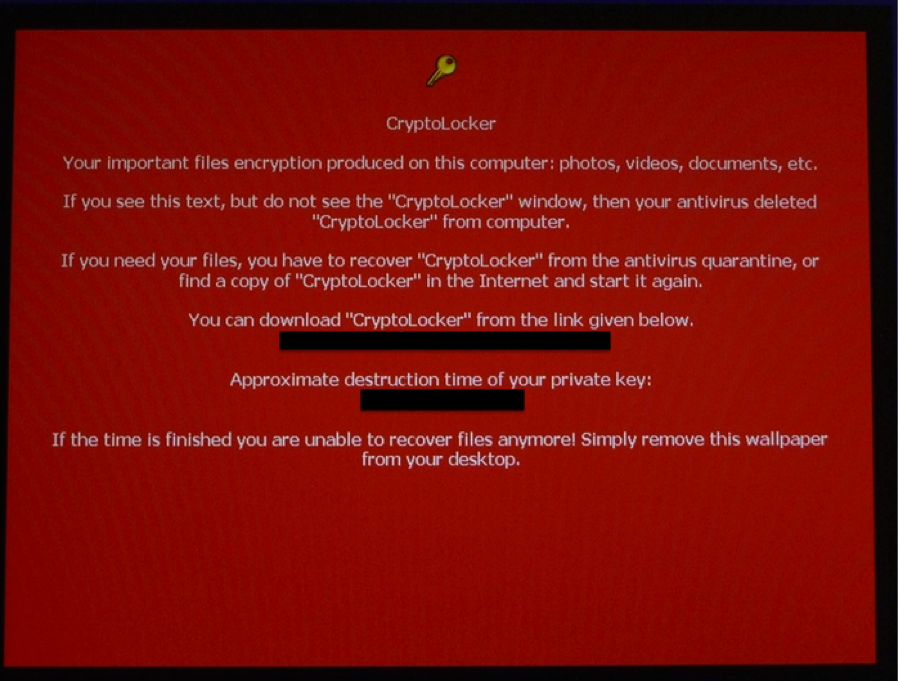
Figure 1: Screenshot of victim machine infected with CryptoLocker
Not all CryptoLocker variants are created equal. There are several copycats and hybrid versions of Crytpolocker that exist, ranging from programs like CryptoDefense, PowerLocker, TorLocker and CryptorBit, to variants that are not necessarily named but have modified functionality, such as using Yahoo Messenger as a propagation technique.
Decryption Assistance
To help solve the problem of victims’ files still being encrypted, we leveraged our close partnership with Fox-IT. We developed a decryption assistance website and corresponding tool designed to help those afflicted with the original CryptoLocker malware. Through various partnerships and reverse engineering engagements, Fox-IT and FireEye have ascertained many of the private keys associated with CryptoLocker. Having these private keys allows for decryption of files that are encrypted by CryptoLocker.
FireEye and Fox IT have created a webpage, https://www.decryptcryptolocker.com, where a user can upload an encrypted CryptoLocker file. Based on this upload, the user will be provided with the option to download a private key that should decrypt their affected files. The site also provides instructions on how to apply this key to the files encrypted by CryptoLocker to decrypt those files.
To use the site, simply upload an encrypted file without any confidential information. (Please keep in mind, we will not permanently store, view, or modify your file in any fashion.) Enter your email address, to ensure the private key associated with the file is sent to the correct individual. Ensure you enter the correct number or phrase in the Captcha entry field.
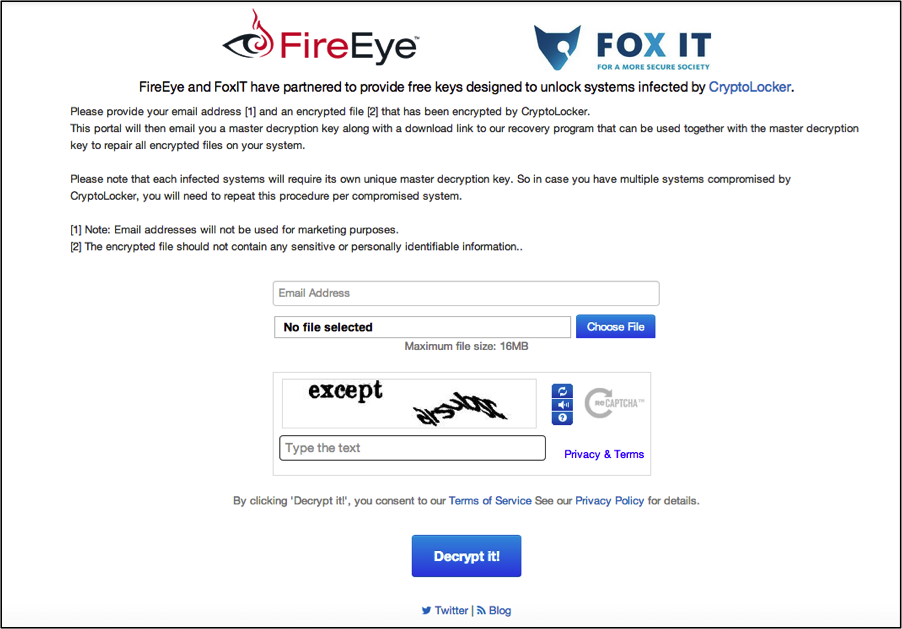
Figure 2: Screenshot of https://www.DecryptCryptoLocker.com
After clicking “Decrypt It!”, you will be presented with instructions to download the Decryptolocker.exe tool from https://www.decryptCryptoLocker.com (Figure 3). In addition, your private key will be sent to the email addresses specified.
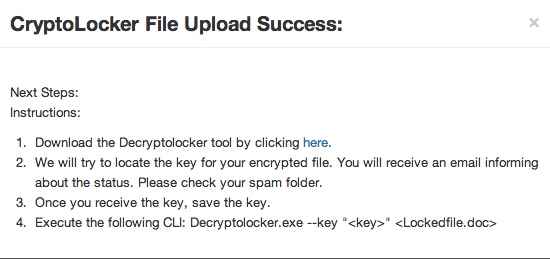
Figure 3: DecryptCryptoLocker decryption result page
After receiving the email (Figure 4), you will then select the key and utilize it in conjunction with Decryptolocker.exe.
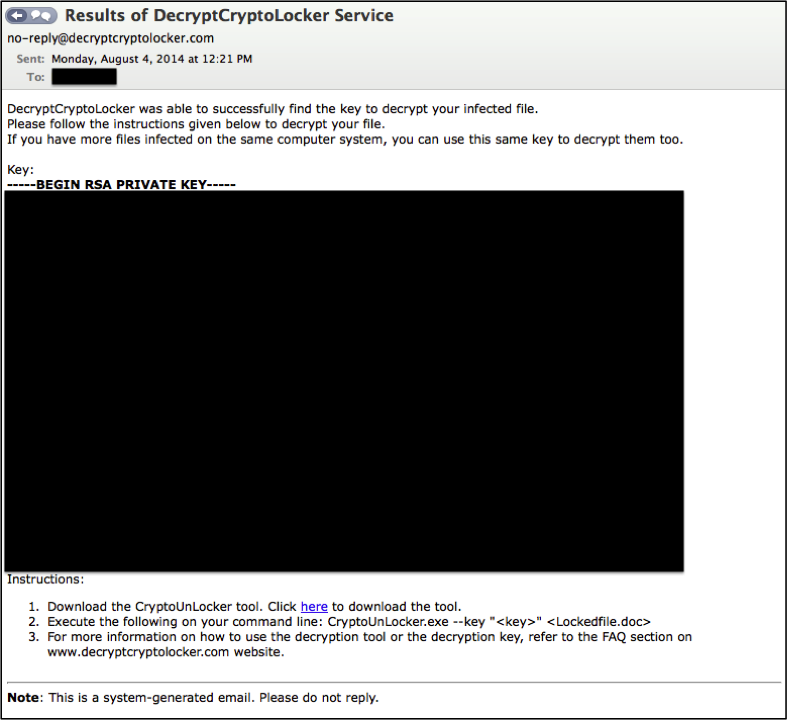
Figure 4: Email containing private key
At this point, the user opens a Windows Command Prompt, and browses to the directory of the Decryptolocker.exe tool and the locked file. (Please note that the directory of the locked file must be specified if the file is not local to the tool’s directory.) The user must enter the command exactly as specified on the successful decryption page. The command structure should be used as the following:
Decryptolocker.exe -key “<key>” <Lockedfile.doc>
Upon successful execution of the tool, the user should be presented with a prompt indicating decryption was successful (Figure 5).

Figure 5: Successful decryption of File1-1.doc
Conclusion
Operation Tovar made a clear impact on the distribution of and infection of machines by CryptoLocker. However, there have been no known avenues available designed to help users get their encrypted files back without making significant payments to those responsible for infecting machines in the first place. While the remediation of infected machines can be somewhat difficult, hopefully with the help of https://www.decryptCryptoLocker.com and Decryptolocker.exe, we can help you get back some of the valuable files that may still be encrypted.
As always, to help prevent a threat like this from affecting you and your data, ensure you backup your data. Ideally, this would be done in at least two locations: One would be on premises (such as an external hard drive), and the other would be off premises (such as cloud storage).
FAQ
Are all encrypted files afflicted with CryptoLocker decryptable with this tool?
We believe we recovered everything the from the CryptoLocker database. However, we are aware that there could be a limited data chunk that could be missing which is related to either the takedown or interruptions of the CryptoLocker backend infrastructure. As a result, certain files may not be decryptable. Also, new variants of CryptoLocker may be released at any time, and the tools we discuss here or have made available may not be able to decrypt files infected with these more recent variants.
Does this tool work against CryptoLocker variants?
There are several variants of CryptoLocker, all functioning in different ways. While these variants do appear similar to CryptoLocker, this tool may not be successful in all decryption processes because of code and functionality variances.
Does any of our data get stored by FireEye or Fox-IT?
Under no circumstances does personal data get stored, processed or examined by FireEye or Fox-IT when using this tool.
Is this service free?
The Decryptolocker.exe tool is available at no cost via the website to anyone that has been compromised with CryptoLocker.
How can I use the Decryptolocker.exe tool?
The Decryptolocker.exe tool is designed to perform a few different types of functions. Here are some examples of various prompts you can enter, depending on the result you would like to obtain.
1) If you would like to test a file if it is encrypted with CryptoLocker, you can enter:
Decryptolocker.exe -find File1.doc
2) If you would like to find all files encrypted with CryptoLocker in a directory, you can enter:
Decryptolocker.exe -find -r “C:\FolderName”
Note: Remember to include the “-r”
3) If you would like to decrypt a file encrypted with CryptoLocker, you can enter:
Decryptolocker.exe -key “<your private key provided in email>” File1.doc
4) If you would like to decrypt all files in a folder, you can enter:
Decryptolocker.exe -key “<your private key provided in email>” C:\FolderName\*
Note: Remember to include the “*” at the end
5) If you would like to decrypt all the files in a folder or drive recursively, you can enter:
Decryptolocker.exe -key “<your private key provided in email>” -r C:\
Note: Decryptolocker.exe creates a backup of all encrypted files in the same directory before writing the decrypted file. If you do not have enough space for these files, then the prompt may not execute, and your computer may run more slowly. Ensure you have sufficient file space before proceeding.
Disclaimers
There are several variants of CryptoLocker, all functioning in different ways. While these variants do appear similar to CryptoLocker, the tools discussed here may not successfully decrypt files encrypted by every variant because of differences in the programs or for other reasons. Also, while we have many unlocking keys, there is a possibility that we will be unable to decrypt your files.
References
https://www.fireeyesolution.com/blog/technical/2014/07/operation-tovar-the-latest-attempt-to-eliminate-key-botnets.html
http://blog.fortinet.com/A-Closer-Look-at-CryptoLocker-s-DGA/
https://www.fox-it.com/en/
Black Hat USA 2014: The Ultimate Cybersecurity Event
Black Hat USA is about to return for its 17th year in Las Vegas, NV. The show will bring together the brightest minds in the world of cybersecurity for a six-day period where learning, networking, and skill-building top the activity list. FireEye will be there in full force.
Here is what you need to know:
- Be on the Look Out: FireEye and Mandiant will have a presence at the conference in booths 411 and 246, respectively. You’ll be able to watch live demos, attend presentations, and get the latest updates on our full platform of technologies and services.
- Jump into the Trenches: Join FireEye CTO Dave Merkel on Thursday, August 7 from 1-2PM for his insightful presentation “Lessons from the Trenches: Advanced Techniques for Dealing with Advanced Attacks” which will review the latest approaches attackers are using to compromise organizations and, more importantly, what the most innovative security teams are doing to stay ahead. Mr. Merkel will be drawing on data and anecdotes from hundreds of organizations, and will outline how leading security teams have reorganized, re-architected and realigned their security strategies.
- Take a Practical View: Visit the FireEye booth (411) for ongoing presentations with a focus on various case studies that can be applied to everyday activities. Presentations will be interactive and include audience responses.
- View Live Demonstrations: FireEye will have eight demo stations networked to live products and solutions to recreate real and recognizable environments.
- Come out and Party: Join the FireEye crew for an event co-sponsored by Rapid7 on Wednesday, August 6 at XS Nightclub in Wynn/Encore. Register for the party here!
- M After Dark: There is nothing quite like Mandiant’s “M After Dark” party, which will take place on August 5, from 7-9PM at the Eye Candy Sound Lounge at Mandalay Bay. Click here for registration information.
We hope to see you in Las Vegas the week of August 2 through August 7. If you are unable to attend, check back on the blog for insights from the conference.
Security as a Differentiator: Investis Partners With FireEye Managed Defense to Offer Its Clients the Very Best in Cybersecurity
This is a contributed post from Alex Booth, COO, Investis
As a provider of digital corporate communication services to many of the world’s leading companies, information security is of critical importance to us here at Investis. In order to be the world’s safest platform for managing digital communications and hosting corporate sites, we wanted the strongest security partner in the business. As COO of Investis, this was a critical decision which is why I wanted to share the reasons we chose FireEye Managed Defense. To give you the short version, though, the choice was easy - the long version of which you can see in the video below or get a synopsis of in this post…
We are an ISO 27001 certified company and a member of CISP, the UK government’s cybersecurity information partnership. We believe you can never take security too seriously, especially in a digital landscape with increasingly sophisticated cybercrime. With that in mind, we wanted the most advanced solution to protect our environment and clients, and FireEye was the perfect partner to help us safeguard against advanced threats.
FireEye is the cybersecurity partner of choice for many of the US’s largest firms and its subsidiary, Mandiant, was selected by the UK Government Communications Headquarters (GCHQ) as one of four vendors certified to respond to cybersecurity attacks targeting the UK’s national infrastructure.
As a result of an on-site assessment by Mandiant consultants, we chose to augment our security team with the FireEye Managed Defense service.
We are looking forward to working with the great team over at FireEye to ensure we offer our clients the very best in cybersecurity.
US GAO Report Highlights Incident Response Shortcomings
On May 30th, 2014, the US Government Accountability Office (GAO) released a report titled “Information Security: Agencies Need to Improve Cyber Incident Response Practices.” GAO conducted its research by randomly selecting six government agencies, then selecting a statistically significant number of incident reports (40 from each organization), documented during 2012. GAO then evaluated how the agencies performed, based on the reports. GAO compared the documented incident response actions to requirements set by the Federal Information Security Management Act of 2002 (FISMA) and National Institute of Standards and Technology (NIST) Special Publication 800-61, Computer Security Incident Handling Guide. The results were surprising and I will explain the significance of several excerpts in this post.
First, “agencies had recorded actions to halt the spread of, or otherwise limit, the damage caused by an incident in about 75 percent of incidents government-wide. However, agencies did not demonstrate such actions for about 25 percent of incidents government-wide.”
This comment references the need to contain an intrusion. If a government agency fails to completely contain an intrusion, any gaps leave the adversary freedom of maneuver. He can exploit the containment failure to proliferate to other systems and remain in control of an organization’s systems. Anything less than 100% containment is essentially 0% containment.
Second, “for about 77 percent of incidents government-wide, the agencies had identified and eliminated the remaining elements of the incident. However, agencies did not demonstrate that they had effectively eradicated incidents in about 23 percent of incidents.”
This comment references the need to remove an intruder from a compromised organization. Similar to the need for 100% containment, one must also achieve 100% removal in order to completely frustrate the adversary. If an adversary retains access to even one system, he can rebuild his position and retake control of the victim.
Third, “agencies returned their systems to an operationally ready state for about 81 percent of incidents government-wide. However, they had not consistently documented remedial actions on whether they had taken steps to prevent an incident from reoccurring. Specifically, agencies did not demonstrate that they had acted to prevent an incident from reoccurring in about 49 percent of incidents government-wide.”
This comment describes the need to learn from intrusions and implement remediation. If a victim fails to make the environment tougher for the adversary, the intruder will likely return using the same techniques that he utilized to first gain access.
Finally, a search of the entire GAO report for the word “strategy” produced zero hits. Beyond being disappointed by the three excerpts I highlighted above, I am dismayed to not hear GAO discuss the need for a security strategy for organizations. Incident response is not a technical action. IR should be part of a business process, done as part of an operation that implements a strategy understood and approved by the highest levels of management. Furthermore, the GAO report did not really evaluate the consequences of the three documented failures and the lack of concrete security strategies. Had GAO taken that step, they might have concluded that the agencies continue to face severe security challenges.
