


Back in July, with the help of Spamhaus and CERT-GIB, FireEye took down Grum, one of the world's largest spam botnets. The whole shutdown operation was like a roller coaster ride and is explained in my previous blog posts here and here. Apart from an unsuccessful recovery attempt made by the bot herders a few days after the takedown, we never noticed any movement from the opposite side. Apparently the Grum guys had given up their botnet.
Author Archives: Atif Mushtaq
Java Zero-Day - First Outbreak
A few days ago I talked about the existence of a new java zero-day flaw (CVE-2012-4681). Soon after the publication of my blog, the white-hats kicked in and there was Proof Of Concept (POC) code ready overnight. At this point, a major outbreak was inevitable. We soon came to know that the master mind behind the Blackhole exploit kit has plans to add this zero-day to his package. This morning we started getting the first indication of a large scale attack. So far we have observed over a dozen domains actively attacking systems with this exploit, and the count is increasing rapidly. After seeing the reliability of this attack, I have no doubt in my mind that within hours the casualties will be in the thousands.
Zero-Day Season is Not Over Yet
New Java zero-day vulnerability has been spotted in the wild. We have seen this unpatched exploit being used in limited targeted attacks. Most of the recent Java run-time environments i.e., JRE 1.7x are vulnerable. In my lab environment, I was able to successfully exploit my test machine against latest version of FireFox with JRE version 1.7 update 6 installed.
Grum—The Money Factor
As expected, the operators behind Grum are trying their best to reclaim their botnet. In the absence of any built-in fallback mechanisms, the bot herders used another fallback mechanism that is called money. Over the weekend we found that the Ukrainian ISP SteepHost removed the null route on three CnCs that were taken down last week. We suspect the bot herders must have paid a large amount of money in order to get access to these servers. We immediately noticed this change and contacted SteepHost once again. After hours of negotiations, they eventually shut down these CnCs once more. During this time there was a short burst of spam sent by Grum, but it has disappeared as of this morning.
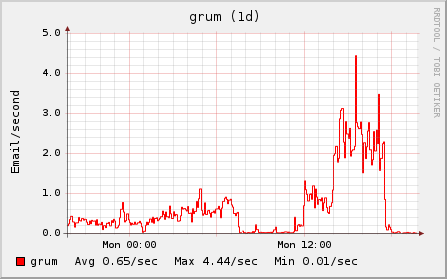
Figure 1. Spam volume during this recovery attempt (Source: SpamHaus)
Grum Recap
Grum, World’s Third-Largest Botnet, Knocked Down
I am glad to announce that, after three days of effort, the Grum botnet has finally been knocked down. All the known command and control (CnC) servers are dead, leaving their zombies orphaned. How it all happened is a long story, but I would like to summarize it for you.
Grum CnCs—Just a few more to go
This post was updated on July 17, 2012, at 3:15 PM.
Last week, I wrote an article covering various aspects of a large spam botnet named Grum. This article mainly covered the current command and control (CnC) coordinates of this botnet. The intention behind this article was not only to share this information for a general awareness, but also to invite the research community to come forward to take down this spam beast. I can see that this strategy is really working. Dutch authorities have pulled the plug on two of the CnC servers pointing to IP addresses 94.102.51.226 and 94.102.51.227.1 Thanks to the Dutch authorities for swift action.
Killing the Beast - Part 5
Back in 2009, I started writing a series of articles called "Killing the Beast." These articles were primarily focused on the command and control (CnC) coordinates of popular spam botnets. These articles not only provided readers greater visibility into these spam botnets, but also served as the basis for two botnet takedowns. So far, four articles under this series have been published. After a long time, I have decided to write the fifth one.
For a refresher, older posts can be accessed using the links shown below:
Part 1, Part 2, Part 3, and Part 4.
In recent years, we have seen the fall of many spam botnets including Srizbi, Rustock, Mega-D, Pushdo.A, Storm, and Waledac. But one botnet that has kept itself well under the radar is the Grum botnet. When I look into my Botnet Lab logs, I can see traces of Grum's earlier versions recorded around February 2008. That means that, as of today, this botnet is more than four years old. Readers who have been following the evolution of different botnets would agree that keeping a botnet active and alive for this many years is an achievement in itself.
Based on the latest statistics from M86Security, Grum is currently responsible for 17.4% of worldwide spam traffic, making it the world's third most active spam botnet after Cutwail and Lethic. Interestingly, Grum, which was once the world's number one spam botnet around January 2012 (at that time, Grum was responsible for 33.3% of worldwide spam), is already on its decline after losing its position to the Cutwail botnet.
Stories About Botnets - Part 2
In the first part of this series, I talked about a few botnets that are using random domain generation algorithms in order to conceal their Command and Control (CnC) servers. But that’s not the only type of evasion being used by advanced malware. There are other types of polymorphism as well.
Some of the polymorphic strains found in these malware are as follows:
- Random domain generation (as I talked about in Part 1)
- Random URL and HTTP header generation
- Custom obfuscated protocols
- Disguised as legitimate objects like a gif or jpeg image file, etc.
Today, I would like to talk about type 2—botnets that are good at randomizing their HTTP communication. Readers will see shortly how intelligently these malware are bypassing signature-based defenses.
Stories About Botnets - Part 1
The malware threat landscape is changing very fast. New and improved malware are hitting the attack surface on a daily basis. No wonder advanced malware like to operate in stealth mode. They try to change their behaviors, shapes and patterns as much as they can do to fool their enemies. Not only do we need a signature-less technology to handle such malware, but we also need a news resource continuously talking about these emerging threats, and this is where a series of blogs on this topic comes into play.
For the first of these series, I am going to talk about four different botnets that have recently been spotted randomizing their command and control domains. I will call these generically “New Botnet” A, B, C, and D so that we can focus on the details of the morphing behaviors. All of these botnets use custom algorithms to generate/locate their CnCs. The use of random CnC domains is not a new concept. In the past, we have seen Conficker, Srizbi, and Rustock using similar techniques, but in recent days we have seen more and more botnets adopting these stealth tactics.
