Operation Poisoned Hurricane: Lessons for CISOs

The tactics described in “Operation Poisoned Hurricane” should come as a stark reminder that advanced threat actors do not stand still. They continue to refine their tradecraft, finding new and innovative ways to bypass security controls and evade detection.

The technical details of the evasion techniques are complex, but the lessons for the CISO are clear:

  1. Traffic to a legitimate website is not always legitimate traffic – malware could be hiding command and control communications in traffic to reputable sites.
  2. Don’t allow direct Internet access, ever. The DNS hijacking described in the blog relies on directly sending DNS queries.
  3. File-based malware controls are being successfully evaded in the wild.

What can you do to protect your organisation from these threats? My suggestions are:

  1. Make sure you have a well-architected Internet proxy architecture that prevents direct connectivity from your network:
    • Never allow hosts other than your secure external DNS resolver to send DNS queries to the Internet. Period.
    • Record all internal DNS queries, these are a possible sign of a compromised machine.
  2. Put in place a malware detection solution that can identify multi-vector, multi-stage malware execution:
    • These attacks used legitimate, signed binaries from a known security company to load malicious code contained in other files as part of a multi-stage attack. File-oriented security controls do not detect these attacks, you need a full behavioural analytics engine to see the attack.
    • Don’t assume that a signed binary is safe. Automated analysis of code behaviour in an execution environment is critical.
  3. Ensure you can detect and block command & control traffic from compromised users, even if it is to legitimate websites:
    • Sophisticated attackers can use blogs, code repositories, even comments on social media, to send and receive command & control signals.
    • Reputation-based detection is not sufficient, you need detection and protection that can understand new command and control tactics based on automated behavioural analysis.

The attackers are evolving their attacks, are you evolving your defenses fast enough to keep them out?

Your Locker of Information for CryptoLocker Decryption

Ransomware is a particularly nasty piece of malware that takes infected machines hostage. CryptoLocker was successful at garnering multi-millions in ransom payments the first two months of CryptoLocker’s distribution, according to a recent blog by FireEye regarding the takeover of CryptoLocker infrastructure - Operation Tovar.

Operation Tovar helped tear down the infrastructure used by attackers, but there are still many instances where users are still being infected with ransomware. After the success of Operation Tovar, there were few resources available to help decrypt files that were still encrypted with the attacker’s private key.

While not particularly innovative, CryptoLocker was successful because it encrypts the files of computers it infected and then demanded a ransom for a private key to decrypt those files. The harsh reality of a situation like this is, not many people back up their data. In some cases, the backups would be encrypted if mounted to an infected machine. As a result, many of the victims felt helpless at this point, and paid the ransom - typically around $300. A simple description of the way that CryptoLocker works can be found below:

  1. CryptoLocker arrives on a victim’s machine through a variety of techniques such as spear-phishing emails or watering hole attacks.
  2. CryptoLocker then connects to randomly generated domain (via DGAs) to download a specific RSA public key.
  3. At that point, an AES-256 key is created for each file on the system.
  4. CryptoLocker then encrypts all of the supported files using the generated key from step 3.
  5. The generated key is then encrypted with the downloaded RSA public key from step 2.
  6. And finally, the AES-key is written to the beginning of the encrypted files, thus requiring the private key to decrypt.
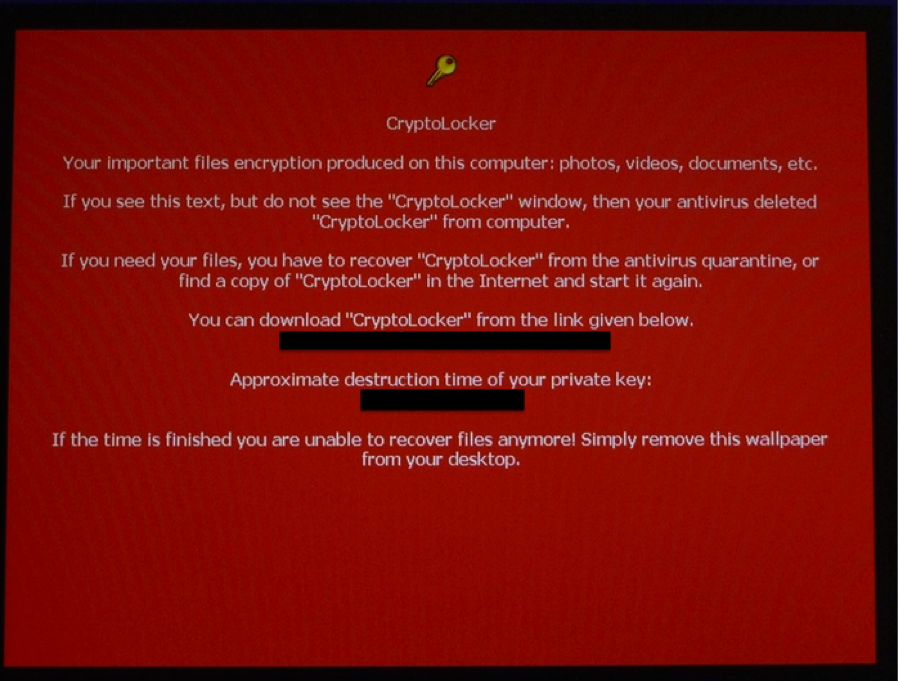
crypto1

Figure 1: Screenshot of victim machine infected with CryptoLocker

Not all CryptoLocker variants are created equal. There are several copycats and hybrid versions of Crytpolocker that exist, ranging from programs like CryptoDefense, PowerLocker, TorLocker and CryptorBit, to variants that are not necessarily named but have modified functionality, such as using Yahoo Messenger as a propagation technique.

Decryption Assistance

To help solve the problem of victims’ files still being encrypted, we leveraged our close partnership with Fox-IT. We developed a decryption assistance website and corresponding tool designed to help those afflicted with the original CryptoLocker malware. Through various partnerships and reverse engineering engagements, Fox-IT and FireEye have ascertained many of the private keys associated with CryptoLocker. Having these private keys allows for decryption of files that are encrypted by CryptoLocker.

FireEye and Fox IT have created a webpage, https://www.decryptcryptolocker.com, where a user can upload an encrypted CryptoLocker file. Based on this upload, the user will be provided with the option to download a private key that should decrypt their affected files. The site also provides instructions on how to apply this key to the files encrypted by CryptoLocker to decrypt those files.

To use the site, simply upload an encrypted file without any confidential information. (Please keep in mind, we will not permanently store, view, or modify your file in any fashion.) Enter your email address, to ensure the private key associated with the file is sent to the correct individual. Ensure you enter the correct number or phrase in the Captcha entry field.
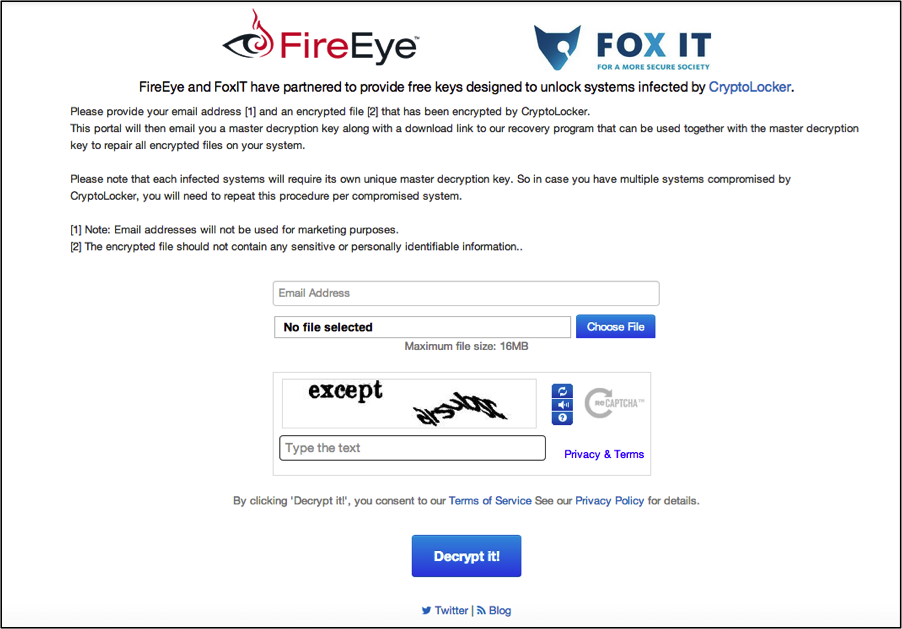
crypto2

Figure 2: Screenshot of https://www.DecryptCryptoLocker.com

After clicking “Decrypt It!”, you will be presented with instructions to download the Decryptolocker.exe tool from https://www.decryptCryptoLocker.com (Figure 3). In addition, your private key will be sent to the email addresses specified.
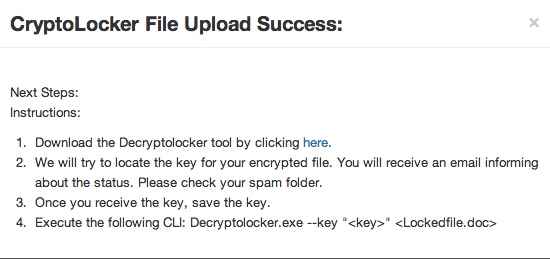
crypto32

Figure 3: DecryptCryptoLocker decryption result page

After receiving the email (Figure 4), you will then select the key and utilize it in conjunction with Decryptolocker.exe.
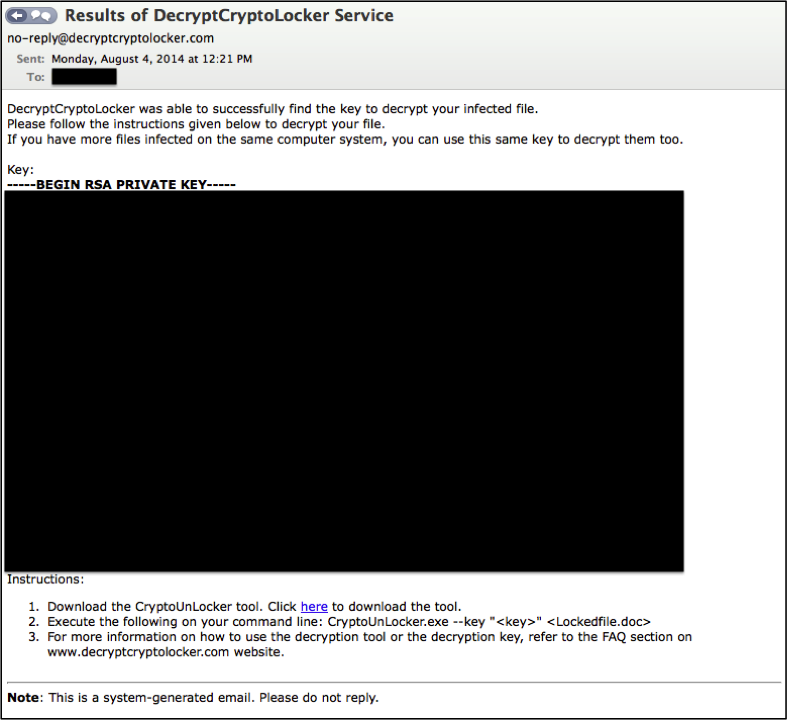
crypto4

Figure 4: Email containing private key

At this point, the user opens a Windows Command Prompt, and browses to the directory of the Decryptolocker.exe tool and the locked file. (Please note that the directory of the locked file must be specified if the file is not local to the tool’s directory.) The user must enter the command exactly as specified on the successful decryption page. The command structure should be used as the following:

Decryptolocker.exe -key “<key>” <Lockedfile.doc>

Upon successful execution of the tool, the user should be presented with a prompt indicating decryption was successful (Figure 5).

crypto5

Figure 5: Successful decryption of File1-1.doc

Conclusion

Operation Tovar made a clear impact on the distribution of and infection of machines by CryptoLocker. However, there have been no known avenues available designed to help users get their encrypted files back without making significant payments to those responsible for infecting machines in the first place. While the remediation of infected machines can be somewhat difficult, hopefully with the help of https://www.decryptCryptoLocker.com and Decryptolocker.exe, we can help you get back some of the valuable files that may still be encrypted.

As always, to help prevent a threat like this from affecting you and your data, ensure you backup your data. Ideally, this would be done in at least two locations: One would be on premises (such as an external hard drive), and the other would be off premises (such as cloud storage).

FAQ

Are all encrypted files afflicted with CryptoLocker decryptable with this tool?

We believe we recovered everything the from the CryptoLocker database. However, we are aware that there could be a limited data chunk that could be missing which is related to either the takedown or interruptions of the CryptoLocker backend infrastructure. As a result, certain files may not be decryptable. Also, new variants of CryptoLocker may be released at any time, and the tools we discuss here or have made available may not be able to decrypt files infected with these more recent variants.

Does this tool work against CryptoLocker variants?

There are several variants of CryptoLocker, all functioning in different ways. While these variants do appear similar to CryptoLocker, this tool may not be successful in all decryption processes because of code and functionality variances.

Does any of our data get stored by FireEye or Fox-IT?

Under no circumstances does personal data get stored, processed or examined by FireEye or Fox-IT when using this tool.

Is this service free?

The Decryptolocker.exe tool is available at no cost via the website to anyone that has been compromised with CryptoLocker.

How can I use the Decryptolocker.exe tool?

The Decryptolocker.exe tool is designed to perform a few different types of functions. Here are some examples of various prompts you can enter, depending on the result you would like to obtain.

1) If you would like to test a file if it is encrypted with CryptoLocker, you can enter:
Decryptolocker.exe -find File1.doc

2) If you would like to find all files encrypted with CryptoLocker in a directory, you can enter:

Decryptolocker.exe -find -r “C:\FolderName”

Note: Remember to include the “-r”

3) If you would like to decrypt a file encrypted with CryptoLocker, you can enter:

Decryptolocker.exe -key “<your private key provided in email>” File1.doc

4) If you would like to decrypt all files in a folder, you can enter:

Decryptolocker.exe -key “<your private key provided in email>” C:\FolderName\*

Note: Remember to include the “*” at the end

5) If you would like to decrypt all the files in a folder or drive recursively, you can enter:

Decryptolocker.exe -key “<your private key provided in email>” -r C:\

Note: Decryptolocker.exe creates a backup of all encrypted files in the same directory before writing the decrypted file. If you do not have enough space for these files, then the prompt may not execute, and your computer may run more slowly. Ensure you have sufficient file space before proceeding.


Disclaimers

There are several variants of CryptoLocker, all functioning in different ways. While these variants do appear similar to CryptoLocker, the tools discussed here may not successfully decrypt files encrypted by every variant because of differences in the programs or for other reasons. Also, while we have many unlocking keys, there is a possibility that we will be unable to decrypt your files.

References


https://www.fireeyesolution.com/blog/technical/2014/07/operation-tovar-the-latest-attempt-to-eliminate-key-botnets.html

http://blog.fortinet.com/A-Closer-Look-at-CryptoLocker-s-DGA/

https://www.fox-it.com/en/

Black Hat USA 2014: The Ultimate Cybersecurity Event

Black Hat USA is about to return for its 17th year in Las Vegas, NV. The show will bring together the brightest minds in the world of cybersecurity for a six-day period where learning, networking, and skill-building top the activity list. FireEye will be there in full force.

Here is what you need to know:

  • Be on the Look Out: FireEye and Mandiant will have a presence at the conference in booths 411 and 246, respectively. You’ll be able to watch live demos, attend presentations, and get the latest updates on our full platform of technologies and services.
  • Jump into the Trenches: Join FireEye CTO Dave Merkel on Thursday, August 7 from 1-2PM for his insightful presentation “Lessons from the Trenches: Advanced Techniques for Dealing with Advanced Attacks” which will review the latest approaches attackers are using to compromise organizations and, more importantly, what the most innovative security teams are doing to stay ahead. Mr. Merkel will be drawing on data and anecdotes from hundreds of organizations, and will outline how leading security teams have reorganized, re-architected and realigned their security strategies.
  • Take a Practical View: Visit the FireEye booth (411) for ongoing presentations with a focus on various case studies that can be applied to everyday activities. Presentations will be interactive and include audience responses.
  • View Live Demonstrations: FireEye will have eight demo stations networked to live products and solutions to recreate real and recognizable environments.
  • Come out and Party: Join the FireEye crew for an event co-sponsored by Rapid7 on Wednesday, August 6 at XS Nightclub in Wynn/Encore. Register for the party here!
  • M After Dark: There is nothing quite like Mandiant’s “M After Dark” party, which will take place on August 5, from 7-9PM at the Eye Candy Sound Lounge at Mandalay Bay. Click here for registration information.

We hope to see you in Las Vegas the week of August 2 through August 7. If you are unable to attend, check back on the blog for insights from the conference.


Security as a Differentiator: Investis Partners With FireEye Managed Defense to Offer Its Clients the Very Best in Cybersecurity

This is a contributed post from Alex Booth, COO, Investis

As a provider of digital corporate communication services to many of the world’s leading companies, information security is of critical importance to us here at Investis. In order to be the world’s safest platform for managing digital communications and hosting corporate sites, we wanted the strongest security partner in the business. As COO of Investis, this was a critical decision which is why I wanted to share the reasons we chose FireEye Managed Defense. To give you the short version, though, the choice was easy - the long version of which you can see in the video below or get a synopsis of in this post…

We are an ISO 27001 certified company and a member of CISP, the UK government’s cybersecurity information partnership. We believe you can never take security too seriously, especially in a digital landscape with increasingly sophisticated cybercrime. With that in mind, we wanted the most advanced solution to protect our environment and clients, and FireEye was the perfect partner to help us safeguard against advanced threats.

FireEye is the cybersecurity partner of choice for many of the US’s largest firms and its subsidiary, Mandiant, was selected by the UK Government Communications Headquarters (GCHQ) as one of four vendors certified to respond to cybersecurity attacks targeting the UK’s national infrastructure.

As a result of an on-site assessment by Mandiant consultants, we chose to augment our security team with the FireEye Managed Defense service.

We are looking forward to working with the great team over at FireEye to ensure we offer our clients the very best in cybersecurity.

US GAO Report Highlights Incident Response Shortcomings

On May 30th, 2014, the US Government Accountability Office (GAO) released a report titled “Information Security: Agencies Need to Improve Cyber Incident Response Practices.” GAO conducted its research by randomly selecting six government agencies, then selecting a statistically significant number of incident reports (40 from each organization), documented during 2012. GAO then evaluated how the agencies performed, based on the reports. GAO compared the documented incident response actions to requirements set by the Federal Information Security Management Act of 2002 (FISMA) and National Institute of Standards and Technology (NIST) Special Publication 800-61, Computer Security Incident Handling Guide. The results were surprising and I will explain the significance of several excerpts in this post.

First, “agencies had recorded actions to halt the spread of, or otherwise limit, the damage caused by an incident in about 75 percent of incidents government-wide. However, agencies did not demonstrate such actions for about 25 percent of incidents government-wide.”

This comment references the need to contain an intrusion. If a government agency fails to completely contain an intrusion, any gaps leave the adversary freedom of maneuver. He can exploit the containment failure to proliferate to other systems and remain in control of an organization’s systems. Anything less than 100% containment is essentially 0% containment.

Second, “for about 77 percent of incidents government-wide, the agencies had identified and eliminated the remaining elements of the incident. However, agencies did not demonstrate that they had effectively eradicated incidents in about 23 percent of incidents.”

This comment references the need to remove an intruder from a compromised organization. Similar to the need for 100% containment, one must also achieve 100% removal in order to completely frustrate the adversary. If an adversary retains access to even one system, he can rebuild his position and retake control of the victim.

Third, “agencies returned their systems to an operationally ready state for about 81 percent of incidents government-wide. However, they had not consistently documented remedial actions on whether they had taken steps to prevent an incident from reoccurring. Specifically, agencies did not demonstrate that they had acted to prevent an incident from reoccurring in about 49 percent of incidents government-wide.”

This comment describes the need to learn from intrusions and implement remediation. If a victim fails to make the environment tougher for the adversary, the intruder will likely return using the same techniques that he utilized to first gain access.

Finally, a search of the entire GAO report for the word “strategy” produced zero hits. Beyond being disappointed by the three excerpts I highlighted above, I am dismayed to not hear GAO discuss the need for a security strategy for organizations. Incident response is not a technical action. IR should be part of a business process, done as part of an operation that implements a strategy understood and approved by the highest levels of management. Furthermore, the GAO report did not really evaluate the consequences of the three documented failures and the lack of concrete security strategies. Had GAO taken that step, they might have concluded that the agencies continue to face severe security challenges.

Network Forensics: Use Cases In the Enterprise

Network forensics is an important component of a successful security operations program. It is an important capability that provides a data of record for the incident responder and plays an important role in the daily security operations workflow. While the utility and importance of network forensics may be clear to the security professional, that value may be difficult to communicate to the business decision maker or executive. In this post, I’d like to discuss several business use cases for network forensics that may help communicate the value and business need for network forensics as an integral component of incident response.

Breach Response

When an organization discovers, or is notified of a breach, time becomes of the essence. The organization’s immediate focus becomes moving quickly from detection to containment. In order to make this move, the organization needs to answer a set of essential questions aimed at identifying the extent of the breach and the damage caused by it. This process is often called breach response and involves investigation, analysis, and forensics. Examples of some of the questions that will need to be answered are:

  • How long has this activity been going on (i.e., when did the intrusion begin)?
  • Is the activity still going on?
  • How many systems were affected?
  • What data was taken?
  • Was any sensitive, proprietary, or confidential information taken?

These and other relevant questions are designed to focus the organization on rapidly identifying the extent of the damage, both for containment purposes, but also to address potential public relations, legal, and privacy concerns. For example, consider the case where a law enforcement agency approaches a business (of any size) and informs them that they have been breached and have been observed communicating with a known drop site. The organization will have many questions, including, among many others, those listed above. An accurate, cohesive, lossless data of record is required to properly answer all of the necessary questions. Further, it’s not sufficient merely collect the data, but rather, it must be easy to precisely, incisively, and rapidly extract that data for analysis and forensics.

Hunting

On any network, there will be unusual or suspect activity from time to time. Sometimes, this unusual activity can be indicative of advanced threats and targeted activity. Many times, the threat actors are quite adept at keeping a low profile and executing actions on objectives subtly. For example, Advanced Persistent Threat (APT) actors may compromise an endpoint inside of an organization and slowly collect sensitive, proprietary, or confidential information to stage for subsequent exfiltration. While detecting this activity in an automated fashion would be ideal, this turns out to be very difficult in practice. As a result, if this activity is successfully detected within the organization (as opposed to via a third party), it is most often done so via hunting. Hunting is the activity through which skilled analysts use a variety of different analytical techniques to “slice and dice” the network traffic data in the “hunt” for this subtle malicious activity. The best analysts will want to issue targeted, precise, incisive queries designed to extract the proper forensics data rapidly, with minimal noise. This requires a network forensics capability that can rise to this challenge at enterprise network speeds and traffic volumes.

Metrics/Network Knowledge

Metrics provide important data points to the decision maker and executive. As a recent example, let us consider the many new Top Level Domains (TLDs) that have become available for use. Attackers have already leveraged some of these TLDs for malicious purposes, and this activity will undoubtedly continue to increase. This example begs the question: If a TLD serves no legitimate business purpose and can only expose the organization to risk, should it be blocked proactively? I believe the answer to this question is yes. But how can we ensure that a TLD serves no business purpose? This is where the metrics and network knowledge become so crucial. Business decisions should be based on facts, and facts come from an accurate, precise data of record – the network forensics data. This is merely one example of the many business questions that can be answered with metrics driven by network forensics data. When business decision makers or executives need answers, it is best to be able to provide answers based on ground truth.

Intelligence

When leveraged properly, actionable intelligence can provide additional enrichment and maturity to a security operations program, as well as aid in the improved detection of intrusions. Leveraging intelligence properly involves many details, but one of the most important details is that a reliable data of record exists. After various Indicators of Compromise (IOCs) are received and vetted, they should be leveraged against a reliable data of record in order to maximize their value. There are two time-based aspects here – historical and ongoing. We can run IOCs against our historical data to check for evidence of intrusions present on the network from the past on through the current day. In addition to that, we should also monitor for evidence of intrusions on an ongoing basis and raise an event to the alert queue when we see that evidence. These are both productive activities, assuming that an accurate, cohesive, lossless data of record exists for us to run the IOCs against. Further, it is not merely enough to collect the data – we need to be able to rapidly and surgically extract the data through targeted, precise, and incisive queries. For example, an organization may receive a daily feed of malicious command and control domain names from one or more of its intelligence sources. That data needs to be run against a corresponding data of record to find instances of command and control activity present on the organization’s network indicating that some systems are compromised. A scalable network forensics solution, one that can both record all of the network data at high speed as well as make that data and meta-data available for analysis, is required in order to properly leverage intelligence.

DNS/Passive DNS

Data from Domain Name System (DNS) queries and responses provide a wealth of insight into unusual or suspect activity that may be occurring on the network. For example, most users pointing their browsers at legitimate websites will request domain names that resolve to routable, public IP addresses. But what if a resource on the network repeatedly requests a domain name that resolves to private, non-routable IP address or one that has no resolution at all? Further, what if that domain name suddenly “comes alive” and begins resolving to a routable, public IP address and/or the resource begins exfiltrating data to that IP address? This is just one of many interesting applications of DNS query and response data. As interesting and crucial as this data is, many organizations struggle to maintain adequate visibility across their DNS infrastructure. There are many reasons why this is the case, but there is a solution. A network forensics platform collects layer 7 enriched meta-data for many application protocols, DNS among them. This provides an organization with a de facto DNS monitoring and passive DNS data collection system, without requiring the organization to invest in additional technology or hardware. It’s one of my favorite use cases for network forensics and likely one that will resonate with many readers. For smaller organizations, there is also the additional benefit of using using one network forensics technology for multiple purposes.

Intelligent Alerting

As the old saying goes, ask a stupid question, get a stupid answer. The modern attacker is intelligent and sophisticated. We would be naïve to think that we could identify a sly attacker’s subtle activity with dull, generic queries. If we want to find the intelligent attacker, we need to ask intelligent questions. Asking intelligent questions requires two fundamental components. The first required component is that the data be collected and its associated meta-data extracted and indexed for rapid search. The second required component is a robust query language that allows the analyst to ask incisive, targeted, precise, intelligent questions of the data. It’s likely not a surprise that a mature, scalable, powerful network forensics solution provides both of these required components. For example, say I am a mid-sized organization concerned by potential theft of intellectual property from my executives. With the right solution in place, I can precisely craft my alert logic so as to focus in on the specific employees, systems, data, and threats I am concerned with. In the absence of that capability, many organizations struggle to issue queries powerful enough to identify suspicious and malicious activity designed to behave subtly and fly under the radar.

There are many use cases for network forensics, but I’ve tried to list those that may help to reinforce the strong business need for network forensics. When the need arises to perform breach response or any of the other use cases listed above, the organization that has implemented a robust, scalable network forensics solution will fare better than the organization that has not. With the stakes so high these days, it would be a shame not to be prepared.

BrutPOS From a Security Practioner’s Perspective

Today, FireEye Labs posted a technical blog on the malware for a botnet that we call BrutPOS. With a lot of attention focused on data breaches in retail, BrutPOS gives us a chance to look retrospectively on the state of retail security.

The popular phrase “a chain is only as strong as its weakest link” has great relevance in the information security world. There are a large number of ways to compromise a business network, yet attackers are quite successful in this endeavor using fairly pedestrian methods of attack. This raises the important question: Why is this the case? Part of the answer lies in the fact that attackers don’t feel a great need to use particularly sophisticated attack methods. In other words, if attackers can succeed using fairly elementary attack methods, why should they work any harder? Let’s examine this principle through the example of the BrutPOS malware.

Most businesses use Microsoft’s Remote Desktop Protocol (RDP) as an integral part of their day-to-day business operations. RDP allows for remote login to Windows systems. This has many legitimate uses, such as an administrator logging on to a system remotely to update a software package. Like any legitimate service, attackers are also quite happy to leverage RDP for their own nefarious purposes. An example of this is the BrutPOS malware, the analysis of which was detailed in a FireEye blog post today. At a high level, the purpose of the BrutPOS malware is to compromise Point of Sale (POS) terminals through the use of the remote desktop protocol (RDP). The malware aims to steal payment card information from those compromised POS terminals. There is no need for the attackers to write a sophisticated protocol for their malware to log on to systems remotely – the RDP works quite nicely.

There are many approaches an organization can take to better manage the risk presented in the BrutPOS malware. One of those approaches is to go back to basics and remember some important foundational tenets of information security. This approach involves ensuring that authentication and authorization policies are sensible and enforced across the organization. For example, some simple steps an organization can take to improve its defenses against threats such as BrutPOS include (but are not limited to):

  • Not allowing administrative access to systems, with the exception of special administrative accounts for administrators
  • Locking out accounts after N number of incorrect login attempts
  • Not allowing RDP login by default on systems, but rather, granting it on an as needed basis
  • Limiting or eliminating the use of shared or group accounts
  • Monitoring authentication logs for repetitive failed login attempts to one system or multiple systems

As organizations look to continually improve their information security postures, it’s important to remember that foundational tenets are as valid as ever. We do need to ensure that we have a variety of defensive measures in our arsenal, but it’s important to remember that not all of them need be cutting edge. Sometimes, foundational best practices can provide us with straightforward approaches to mitigating risk posed by modern threats.

Economics of Security Part II: Qualifying the Economic Return From Cybersecurity Solutions

In part one of this series, my colleague, Bryce Boland, CTO, APAC touched on aligning a security program with the value-areas of a business. To be successful in this endeavor, you must calculate the return on investment (ROI) that a robust security program will offer. In part two, I will offer recommendations to achieving this.

The economics of security is an interesting challenge. I polled some contacts and discovered that, as much as we focus on reducing the capex on software and hardware, the majority of costs are actually opex. Therefore if we want to drive efficiencies in security, we should look at the usability (i.e. the time and costs required to achieve the desired outcome) of the tools as much as what they actually do.

Cybersecurity is a multi-dimensional problem, so whilst we consider efficiencies we must look at them in the context of outcomes and value. Our value question in cybersecurity has two factors: (1) are we able to leverage the most efficient path to obtain the solution and (2) being able prioritize on events/incidents that have the greatest business impact.

Simple event/incident response process

The rudimentary processes behind cyber have been around for years and are well documented in various standards. There’s a catalyst event that drives us to understand the problem, so we can qualify and prioritize if and when we need to respond – i.e. solve the problem.

Screen Shot 2014-07-02 at 10.41.08 PM

Are we increasing or decreasing efficiencies?

In recent years many have suggested the logic that “big data” can help us make smart decisions. Yet there is danger that this can create a spiral effect that has the potential to cripple us. By adding more content, we increase the cycles required to understand, qualify and respond. There is also a key question around the quality of that data. Take for example all the events we aggregate into a SIEM tool today, how many of those are truly worth taking action on?

How do we measure success and value?

If we are to evaluate the economic value cyber security solutions bring we need to look less at what they do and instead more how they do it. We need to understand the quality of the information they provide, both in terms of business impact and conversion to action, as well as the operational cycles required to achieve this; which are the cost & time multipliers.

As our technology world complexity continues, the operational aspect as a multiplier can only increase. Today I hear more companies asking for partnerships to solve problems rather than products; they see the time and skills challenge in solving the problem as prohibitive. If we are to succeed today, we need outcome focused solutions; that is they are efficient in providing actionable responses that are business oriented in their focus and/or services that reduce the operation costs associated with time to action. So how do we evaluate this in our buying criteria?

There have been many ROI tools that try to qualify the potential value that come from security investments. However if we are to align to business goals, we must drill into the process behind event correlation/validation – the heart of security – for business impact assessment and response actions.

Qualifying economic value from event/incident management

The framework below aims to give you a reference point to start to map out the economics of your security program.

Given solving this problem is entirely dependent on each individual organization; we must be able to qualify what makes our businesses profitable and how technology enables this. The model does not include metrics in each part of the incident lifecycle but does highlight some of the common key success metrics.

To make economic judgments, you need to assess the following:

  1. What is the ratio between events received and action taken?
  2. What is the efficacy level in the events & incidents you identify (i.e. the real cyber attack event to false positive ratio)?
  3. How many cycles do you iterate through to get from an event(s) to an action; is it timely and cost efficient? (Can you rank the processes/tools you leverage today in terms of man-hours and skills required to get to to action?)
  4. Do you align, prioritize and qualify events against against business goals and impact (How many cycles does this take)?
  5. Make the assessment using the framework & success criteria below to evaluate the key time and cost multipliers in your event/incident security process, so you can validate the economic value that comes from the processes and tools you leverage today, to see which are effective and which are not?
Measures of effectiveness of event/incident management

Measures of effectiveness of event/incident management

In conducting the evaluation process above (and visually outlined above), there is a defined process for tying operational expenditures with investments for securing the processes that generate business value. By analyzing the actions taken to conduct security operations and the, ideally, efficiencies in doing so, security leaders will be able to provide a full picture of their impact on the business. Ultimately, this changes the security conversations from just security to business practices overall.

Economics of Security Part I: Translating Information Security Risks to Business Risk

In this two-part series, my colleague, Greg Day, VP & CTO EMEA and I will focus on making the business case for security solutions that will protect your organization.

One of the many challenges IT Security professionals face is translating the security risks of technologies into the business risks they pose to the company. This translation is critical to building buy-in from your business to fund security initiatives and ensure your projects are funded properly relative to the myriad other things your business is pursuing with its money.

But where should you start? I’ve found that the best place to start is by looking at the processes in the business that generates value. These are the parts of the business that a results-oriented manager will want to protect from threat. By describing security risks in terms of how critical business processes – and their subsequent value generation – could be disrupted, your concern will resonate better with management. Consider the total business value that process generates today – is it 15 percent of the business or 85 percent? Give it a dollar figure. Given your assessment of the likely threat actors and security risks, how much of that value could be destroyed? This is a simple measure of the possible direct or immediate loss that could be experienced – something management are often measured and rewarded on.

Next you can look at knock-on impacts – this too helps speak to the management incentives. If the security risk manifests and creates a specific and significant business impact, would the market, regulators or customers notice? Would the stock price of the company drop as a result? Most business leaders will have a significant and direct interest in market valuation as their remuneration is often closely linked to the company’s stock market performance. Similarly, ask what is the business impact if a security failure leads to a loss of customers, of transaction volume, or increased regulatory scrutiny? Could you face a class action suit?

Sometimes the link between the business value generated and the technology underpinning it is a little hazy, but any modern business process that creates value will leverage and create data. It might be your customer data, the “secret sauce” of your products, a manufacturing capability that ensures your product has the best quality, the output from your R&D team, or perhaps it’s the plans for your next new business. Whatever this data is, and how you depend on it in your business, ensuring it is protected from threats is the difference between success and failure for many companies. Often this data is what the attacker is after. From a business perspective, the reliance on this data to operate the business effectively is how you connect the security risk to the business risk.

What are the most important assets and data in your business that create real value? This is very specific to every business. Think like an attacker: if you were to attack your business, what information would you steal, and why? What could you monetize, use to gain economic advantage, or gain market share? You can assess the value of that asset to your company in terms of potential losses from the dependent business processes, and the value of that asset to an attacker. Then determine how much you should invest to protect against the risks from cybersecurity threats. By going through the process of understanding how data and IT assets are part of the value creation in your business, you actually create the story to help understand the business risk, because you construct the discussion starting from the business process first.

Sometimes the most valuable thing you have is access to your customers. If your customers are large companies, this might make you a springboard to attack a smaller company – and likewise for a larger company your greatest security risks could be exposure to the less security aware vendors in your operations and supply chain. Make sure to consider these scenarios when talking to your business. As larger organizations consider the risks in their supply chain, they will increasingly consider security requirements in MSAs and demand not just compliance but demonstrable security capabilities in their business partners. It is a logical extension of risk management thinking to consider the broader supply chain risks as part of overall business risk management, and this will drive many smaller businesses to invest in improved security capabilities.

More than half the organizations we surveyed do not regularly assess their information security investments in terms of their value relative to the business process they protect. My recommendation is to re-evaluate your investment plan annually, and ensure that your continued security investments are relevant to the threats your business faces. You might also consider using a risk framework like ISO27005 as a tool to help you manage this in a consistent way, to prioritize risks and corresponding investments.

To summarize: understand how and where your business makes its money, illustrate the dependency on technology and data, then explain security risks in terms of the business impact.

In the second part of this series, Greg will discuss how to measure the economic value of your cybersecurity solutions.

Key Themes From the 2014 Gartner Security Summit

Last week, Gartner held its security summit in Washington, DC. A few key themes bubbled to the top during the course of the conference.

Theme #1: Security needs a new architecture
Security architecture requirements will change radically in the coming years. Basically, security will move to a “detect and respond” approach. This was best summarized by one article that covered the conference explaining how vendors are evolving:

[Gartner analyst Neil] MacDonald noted that the need for adaptive security architectures has triggered a land-grab among vendors, large and small, trying to expand their reach, with many rapidly transforming as investors pour money into startups and acquisitions.

FireEye Inc. is at the top of the list, MacDonald said, not only with its January acquisition of Mandiant, but also recently by adding integrated, low-cost IPS capabilities to its threat prevention platform.

Theme #2: Mobile security
Many CISOs expressed mobile security and BYOD as a key area of concern. In one session, mobile application security was mentioned as a key approach to leverage. To succeed, enterprises should evaluate applications by:

  • Testing application source code
  • Testing application behavior
  • Testing communications between the app and web services
  • Automatically submitting apps for testing.
  • Knowing app risk/reputation—using scores
  • Combining and correlating detection with protection.

Theme #3: Incident Response is a core discipline
Under a security paradigm of detect and respond—the importance of incident response has become critical. In one session, analyst Anton Chuvakin laid out a step-by-step approach for incident response. In addition, other sessions frequently alluded to the growing importance of IR.

Theme #4: Dealing with advanced attacks
Dealing with advanced attackers was a high profile topic—with many sessions focusing on the “how-to’s” of blocking an advanced attacker. Most notably, Lawrence Orans gave a talk on the “Five Styles of Stopping Advanced Attacks.” He started the talk stating that “Traditional defense-in-depth components are still necessary, but no longer sufficient.” His framework recommends five styles of advanced threat defense that include:

  • Network traffic analysis
  • Payload Analysis
  • Endpoint behavior analysis
  • Network forensics
  • Endpoint forensics

The conference highlighted a security industry experience in a great deal of flux with the onset of advanced attacks, mobility and more. At the same time, customers want things delivered via the cloud—all the while hoping for a centralized view and management capability. As always, security is changing and evolving—but this year was a little different. General consensus was that few knew where threats were going—but customers want a security architecture that can deal with today’s threats while adapting to ones we haven’t seen yet.