The Path to Mass-Producing Cyber Attacks

Lines of people, lines of parts. The modern production line is composed of individuals contributing to a larger process. This common manufacturing approach is efficient, effective, and profitable.

Now it appears cyber attack groups in the world’s largest manufacturing country are using a similar approach to infiltrate targeted networks and compromise data – collaborating for increased efficiency and effectiveness.

FireEye Labs have published a report – Operation Quantum Entanglement – that details two attack campaigns by different groups in separate regions of China, apparently operating in parallel.

The first group, named Moafee, appears to operate from the Guandong Province. Its targets include the military organizations and governments of countries with national interests in the South China Sea, including some within the U.S. defense industrial base. Moafee may have chosen its targets based on the rich resources of South China Sea region – the world’s second business sea-lane, according to Wikipedia – including rare earth metals, crude oil, and natural gas.

The second group, known as DragonOK, targets high-tech and manufacturing companies in Japan and Taiwan. This may indicate they’re acquiring trade secrets for a competitive economic advantage in the area. DragonOK appears to operate out of China’s Jiangsu Province.

It seems that both groups, while operating in distinctly different regions, either 1) collaborate, 2) receive the same training), 3) share a common toolkit supply chain, or 4) some combination of these scenarios, which means they are employing a ‘production line’-type approach to initiating cyber attacks to breach defenses.

Mirroring Each Other

Both campaigns use similar tools, techniques and procedures (TTPs) – including custom-built backdoors and remote-administration tools (RATs) to infiltrate their targets’ networks.

Moafee and DragonOK both use a well-known proxy tool – HUC Packet Transmit Tool (HTRAN) – to disguise their geographical locations. Both utilize password-protected documents and large file sizes to disguise their attacks. These approaches, along with other similarities in TTPs we’ll review below, seem to indicate the groups are affiliated in some way and have at least some commonality in their attack campaigns.

A third, separate group also appears to be using the same TTPs, including the same custom backdoors and RATs; however, FireEye researchers do not have enough insight to reliably report a definitive connection to the Moafee and DragonOK groups.

Hidden from Sight

Both Moafee and DragonOK favor spear-phishing emails as an attack vector, often employing a decoy to deceive the victim. The emails are well crafted and audience specific, even written in the intended victim’s native language.

Attachments are typically sent as an executable file embedded in a ZIP archive or a password-protected Microsoft Office document. We also observed both groups using decoy documents that are presented to the victim while the malware runs in the background.

The groups both use common, and multiple, methods to hide their activities. Employing sandbox environments, antivirus software and gateway firewalls, they do their best to remain unobtrusive. Methods include:

  • checking for the number of core processors (and quitting if only one is detected);
  • attaching password-protected documents and providing a password in the email contents; and
  • sending large files padded with unnecessary null bites to slide past network- and host-based AV engines that can’t scan larger files.

Tools of the Trade

The two different operators seem to share backdoors and RATs – some of which are custom; others are publicly available. Overlapping tools include:

  • CT/NewCT/NewCT2
  • Mongall
  • Nflog
  • PoisonIvy

We observed Moafee running HTRAN proxies on their multiple Command and Control (C2) servers – all operated on CHINANET, and hosted in Guangdong Province.

Like the Moafee group, we observed DragonOK running HTRAN to proxy their C2 servers, which are also operated on CHINANET but are hosted in the Jiangsu Province.

Summary

Primarily focused on governments and military operations of countries with interests in the South China Sea, Moafee likely chooses its targets based on region’s rich natural resources. By targeting high-tech and manufacturing operations in Japan and Taiwan, DragonOK may be acquiring trade secrets for a competitive economic advantage.

While their targets and missions appear different, our researchers found enough linking evidence to demonstrate a relationship between Moafee and DragonOK, and perhaps even a third attack group. By sharing TTPs and coordinating joint attacks, these advanced threat actors are leveraging China’s supply chain economic expertise to perform extensive worldwide espionage.

Connecting the Dots: Syrian Malware Team Uses BlackWorm for Attacks

The Syrian Electronic Army has made news for its recent attacks on major communications websites, Forbes, and an alleged attack on CENTCOM. While these attacks garnered public attention, the activities of another group - The Syrian Malware Team - have gone largely unnoticed. The group’s activities prompted us to take a closer look. We discovered this group using a .NET based RAT called BlackWorm to infiltrate their targets.

The Syrian Malware Team is largely pro-Syrian government, as seen in one of their banners featuring Syrian President Bashar al-Assad. Based on the sentiments publicly expressed by this group it is likely that they are either directly or indirectly involved with the Syrian government. Further certain members of the Syrian Malware Team have ties to the Syrian Electronic army (SEA) known to be linked to the Syrian government. This indicates that the Syrian Malware Team may also be possibly an offshoot or part of the SEA.

syria1

Banner used by the Syrian Malware Team

BlackWorm Authorship

We found at least two distinct versions of the BlackWorm tool, including an original/private version (v0.3.0) and the Dark Edition (v2.1). The original BlackWorm builder was co-authored by Naser Al Mutairi from Kuwait, better known by his online moniker ‘njq8′. He is also known to have coded njw0rm, njRAT/LV, and earlier versions of H-worm/Houdini. We found his code being used in a slew of other RATs such as Fallaga and Spygate. BlackWorm v0.3.0 was also co-authored by another actor, Black Mafia.

syria2

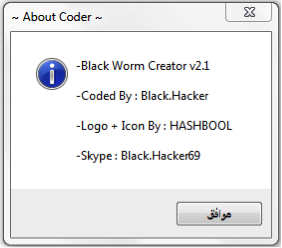
About section within the original version of BlackWorm builder

Within the underground development forums, it’s common for threat actors to collaborate on toolsets. Some write the base tools that other attackers can use; others modify and enhance existing tools.

The BlackWorm builder v2.1 is a prime example of actors modifying and enhancing current RATs. After njq8 and Black Mafia created the original builder, another author, Black.Hacker, enhanced its feature set.

syria3

About section within BlackWorm Dark Edition builder

syria4

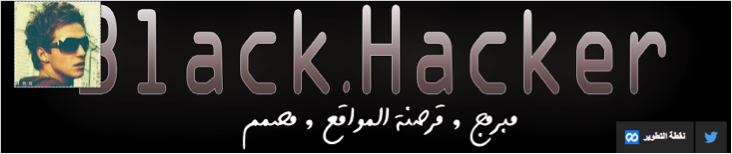
Black.Hacker’s banner on social media

syria5

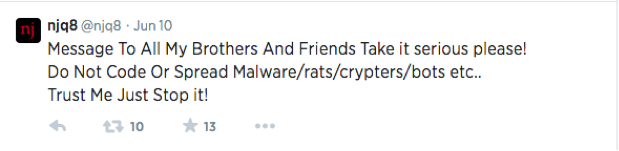
As an interesting side note, ‘njq8′ took down his blog in recent months and announced a cease in all malware development activity on his Twitter and Facebook account, urging others to stop as well. This is likely a direct result of the lawsuit filed against him by Microsoft.

BlackWorm RAT Features

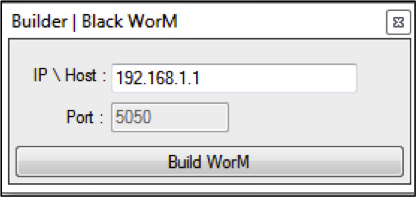
The builder for BlackWorm v0.3.0 is fairly simple and allows for very quick payload, but doesn’t allow any configuration other than the IP address for command and control (C2).

syria6

Building binary through BlackWorm v0.3.0

syria7

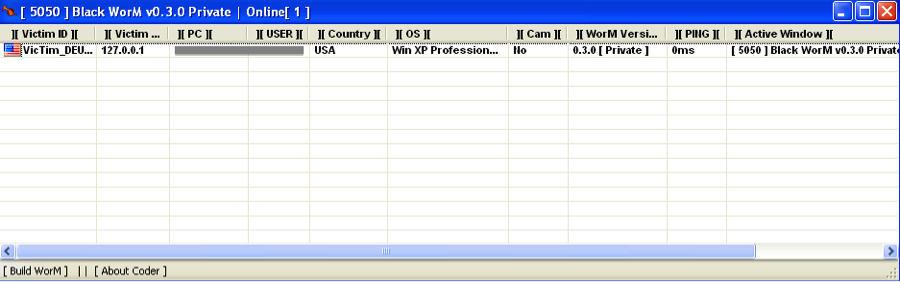
BlackWorm v0.3.0 controller

BlackWorm v0.3.0 supports the following commands between the controller and the implant:

ping Checks if victim is online
closeserver Exits the implant
restartserver Restarts the implant
sendfile Transfer and run file from server
download Download and run file from URL
ddos Ping flood target
msgbox Message interaction with victim
down Kill critical windows processes
blocker Block specified website by pointing resolution to 127.0.0.1
logoff Logout out of windows
restart Restart system
shutdown Shutdown system
more Disable task manager, registry tools, system restore. Also blocks keyboard and mouse input
hror Displays a startling flash video

In addition to the features supported by the command structure, the payload can:

  • Seek and kill no-ip processes DUC30 and DUC20
  • Disable Task Manager to kill process dialog
  • Copy itself to USB drives and create autorun entries
  • Copy itself to common peer-to-peer (P2P) share locations
  • Collect system information such as OS, username, hostname, presence of camera, active window name, etc., to display in the controller
  • Kill the following analysis processes (if found):
    • procexp
    • SbieCtrl
    • SpyTheSpy
    • SpeedGear
    • Wireshark
    • MBAM
    • ApateDNS
    • IPBlocker
    • cPorts
    • ProcessHacker
    • AntiLogger

The Syrian Malware Team primarily uses another version of BlackWorm called the Dark Edition (v2.1). BlackWorm v2.1 was released on a prolific underground forum where information and code is often shared, traded and sold.

syria8

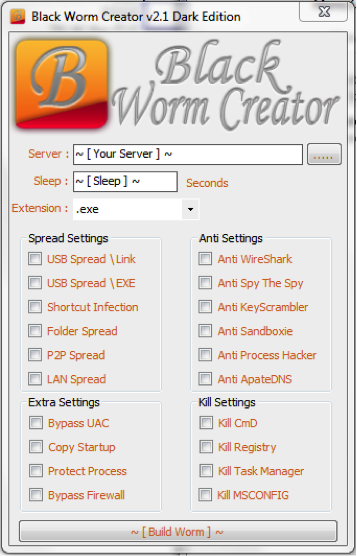
BlackWorm v2.1 has the same abilities as the original version and additional functionality, including bypassing UAC, disabling host firewalls and spreading over network shares. Unlike its predecessor, it also allows for granular control of the features available within the RAT. These additional controls allow the RAT user to enable and disable features as needed. Binary output can be also be generated in multiple formats, such as .exe, .src and .dll.

syria9

BlackWorm Dark Edition builder

Syrian Malware Team

We observed activity from the Syrian Malware Team going as far back as Jan. 1, 2011. Based on Facebook posts, they are allegedly directly or indirectly involved with the Syrian government. Their Facebook page shows they are still very active, with a post as recent as July 16th, 2014.

syria10

Syrian Malware Team’s Facebook page

The Syrian Malware Team has been involved in everything from profiling targets to orchestrating attacks themselves. There are seemingly multiple members, including:

Partial list of self-proclaimed Syrian Malware Team members

Some of these people have posted malware-related items on Facebook.

syria11

Facebook posting of virus scanning of files

While looking for Dark Edition samples, we discovered a binary named svchost.exe (MD5: 015c51e11e314ff99b1487d92a1ba09b). We quickly saw indicators that it was created by BlackWorm Dark Edition.

syria12

Configuration options within code

The malware communicated out to 178.44.115.196, over port 5050, with a command structure of:

!0/j|n\12121212_64F3BF1F/j|n\{Hostname}/j|n\{Username}/j|n\USA/j|n\Win 7 Professional SP1 x86/j|n\No/j|n\2.4.0 [ Dark Edition]/j|n\/j|n\{ActiveWindowName}/j|n\[endof]

When looking at samples of Dark Edition BlackWorm being used by the Syrian Malware Team, the strings “Syrian Malware,” or “Syrian Malware Team” are often used in the C2 communications or within the binary strings.

Additional pivoting off of svchost.exe brought us to three additional samples apparently built with BlackWorm Dark Edition. E.exe, (MD5: a8cf815c3800202d448d035300985dc7) a binary that drew our attention, looked to be a backdoor with the Syrian Malware strings within it.

syria13

When executed, the binary beacons to aliallosh.sytes.net on port 1177. This C2 has been seen in multiple malware runs often associated with Syria. The command structure of the binary is:

!0/j|n\Syrian Malware/j|n\{Hostname}/j|n\{Username}/j|n\USA/j|n\Win 7 Professional SP1 x86/j|n\No/j|n
\0.1/j|n\/j|n\{ActiveWindowName}/j|n\[endof]

Finally, pivoting to another sample, 1gpj.srcRania (MD5:f99c15c62a5d981ffac5fdb611e13095), the same strings were present. The string “Rania” used as a lure was in Arabic and likely refers to the prolific Queen Rania of Jordan.

syria14

The traffic is nearly identical to the other samples we identified and tied to the Syrian Malware Team.

!1/j|n\C:\Documents and Settings\{Username}\Local Settings\Application DataldoDrZdpkK.jpg - Windows Internet Explorer[endof]!0/j|n\Syrian Malware/j|n\{Hostname}/j|n\{Username}/j|n\USA/j|n\Win XP ProfessionalSP2 x86/j|n\No/j|n\0.1/j|n\/j|n\C:\Documents and Settings\{Username}\Local Settings\Application DataldoDrZdpkK.jpg - {ActiveWindowName}/j|n\[endof]

Conclusion

Determining which groups use which malware is often very difficult. Connecting the dots between actors and malware typically involves looking at binary code, identifying related malware examples associated with those binaries, and reviewing infection vectors, among other things.

This blog presents a prime example of the process of attribution. We connected a builder with malware samples and the actors/developers behind these attacks. This type of attribution is key to creating actionable threat intelligence to help proactively protect organizations.

Operation Saffron Rose

There is evolution and development underway within Iranian-based hacker groups that coincides with Iran’s efforts at controlling political dissent and expanding offensive cyber capabilities. The capabilities of threat actors operating from Iran have traditionally been considered limited and have focused on politically motivated website defacement and DDoS attacks.

Our team has published a report that documents the activities of an Iran-based group, known as the Ajax Security Team, which has been targeting both US defense companies as well as those in Iran who are using popular anti-censorship tools to bypass Internet censorship controls in the country.

This group, which has its roots in popular Iranian hacker forums such as Ashiyane and Shabgard, has engaged in website defacements since 2010. However, by 2014, this group had transitioned to malware-based espionage, using a methodology consistent with other advanced persistent threats in this region.

It is unclear if the Ajax Security Team operates in isolation or if they are a part of a larger coordinated effort. We have observed this group leverage varied social engineering tactics as a means to lure their targets into infecting themselves with malware. They use malware tools that do not appear to be publicly available. Although we have not observed the use of exploits as a means to infect victims, members of the Ajax Security Team have previously used exploit code in web site defacement operations.

The objectives of this group are consistent with Iran’s efforts at controlling political dissent and expanding offensive cyber capabilities, but we believe that members of the group may also be dabbling in traditional cybercrime. This indicates that there is a considerable grey area between the cyber espionage capabilities of Iran’s hacker groups and any direct Iranian government or military involvement.

Although the Ajax Security Team’s capabilities remain unclear, we believe that their current operations have been somewhat successful. We assess that if these actors continue the current pace of their operations they will improve their capabilities in the mid-term.

To view a full version of the report on “Operation Saffron Rose,” please visit: https://www.fireeyesolution.com/resources/pdfs/fireeye-operation-saffron-rose.pdf.

From Windows to Droids: An Insight in to Multi-vector Attack Mechanisms in RATs

FireEye recently observed a targeted attack on a U.S.-based financial institution via a spear-phishing email. The payload used in this campaign is a tool called WinSpy, which is sold by the author as a spying and monitoring tool. The features in this tool resemble that of many other off-the-shelf RATs (Remote Administration Tools) available today. We also observed a second campaign by a different attacker where the WinSpy payload was implanted in macro documents to attack various other targets in what appears to be a spam campaign.

The command-and-control (CnC) infrastructure used in the attack against the financial institution is owned and controlled by author of WinSpy. This does not necessarily mean the author is behind attack as the author provides the use of his server for command and control as well as to store the victim data as the default option in the WinSpy package. This feature allowing shared command-and-control infrastructure advertently or inadvertently provides another level of anonymity and deniability for the attacker.

While analyzing the windows payloads for WinSpy we discovered that it also had Android spying components, which we have dubbed GimmeRat. The Android tool has multiple components allowing the victim’s device to be controlled by another mobile device remotely over SMS messages or alternatively through a Windows-based controller. The Windows-based controller is simplistic and requires physical access to the device. The recent surge in Android-based RATs such as Dendroid and AndroRAT shows a spike in the interest of malicious actors to control mobile devices. GimmeRAT is another startling example of malicious actors venturing into the Android ecosystem. Continue reading »

Operation Ephemeral Hydra: IE Zero-Day Linked to DeputyDog Uses Diskless Method

Recently, we discovered a new IE zero-day exploit in the wild, which has been used in a strategic Web compromise. Specifically, the attackers inserted this zero-day exploit into a strategically important website, known to draw visitors that are likely interested in national and international security policy. We have identified relationships between the infrastructure used in this attack and that used in Operation DeputyDog. Furthermore, the attackers loaded the payload used in this attack directly into memory without first writing to disk – a technique not typically used by advanced persistent threat (APT) actors. This technique will further complicate network defenders’ ability to triage compromised systems, using traditional forensics methods.

Enter Trojan.APT.9002

On November 8, 2013 our colleagues Xiaobo Chen and Dan Caselden posted about a new Internet Explorer 0-day exploit seen in the wild. This exploit was seen used in a strategic Web compromise. The exploit chain was limited to one website. There were no iframes or redirects to external sites to pull down the shellcode payload.

Through the FireEye Dynamic Threat Intelligence (DTI) cloud, we were able to retrieve the payload dropped in the attack. This payload has been identified as a variant of Trojan.APT.9002 (aka Hydraq/McRAT variant) and runs in memory only. It does not write itself to disk, leaving little to no artifacts that can be used to identify infected endpoints. Continue reading »

Know Your Enemy: Tracking A Rapidly Evolving APT Actor

Between Oct. 24–25 FireEye detected two spear-phishing attacks attributed to a threat actor we have previously dubbed admin@338.[1] The newly discovered attacks targeted a number of organizations and were apparently focused on gathering data related to international trade, finance, and economic policy. These two attacks utilized different malware families and demonstrate an ability to quickly adapt techniques, tactics, and procedures (TTPs).

Investor Guide and Contact List Lure

On Friday Oct. 25, 2013, FireEye detected an attempted targeted campaign against the following:

  • The Central Bank of a Western European government
  • An International organization involved in trade, economic, and financial policy
  • A U.S.-based think tank
  • A high-ranking government official for a country in the Far East

This spear-phish email, shown in Figure 1, contained a malicious Word document attachment that exploited the CVE-2012-0158 vulnerability.

admin338-phish
Figure 1: Spear-phish email used in a recent admin@338 attack

The malicious Word document had the following properties:

  • File: Investor Relations Contacts.doc
  • MD5: 875767086897e90fb47a021b45e161b2

Continue reading »

Now You See Me - H-worm by Houdini

H-worm is a VBS (Visual Basic Script) based RAT written by an individual going by the name Houdini. We believe the author is based in Algeria and has connections to njq8, the author of njw0rm [1] and njRAT/LV [2] through means of a shared or common code base. We have seen the H-worm RAT being employed in targeted attacks against the international energy industry; however, we also see it being employed in a wider context as run of the mill attacks through spammed email attachments and malicious links.

The Payload

The H-worm payload is simply a VBS file, which is often wrapped, in a PE executable dropper. The H-worm VBS file is also packed with multiple layers of obfuscation in some cases. While analyzing such samples (81c153256efd9161f4d89fe5fd7015bc and 4543daa6936dde54dda8782b89d5daf1), we discovered that they were obfuscated with custom Base64 encoding, multiple levels of standard Base64 encoding (Safa Crypter), and character substitutions. The obfuscation techniques used have been described here [3] already and are summarized in Figure 1 below. There is also an Autoit version of H-worm called the “underworld version” floating around which has the same functionality as the VBS version.

Continue reading »

Evasive Tactics: Taidoor

The Taidoor malware has been used in many ongoing cyber espionage campaigns. Its victims include government agencies, corporate entities, and think tanks, especially those with interests in Taiwan. [1] In a typical attack, targets receive a spear-phishing email which encourages them to open an attached file. If opened on a vulnerable system, malware is silently installed on the target’s computer while a decoy document with legitimate content is opened that is intended to alleviate any suspicions the target may have. Taidoor has been successfully compromising targets since 2008, and continues to be active today. Continue reading »

Operation Molerats: Middle East Cyber Attacks Using Poison Ivy

Don’t be too hasty to link every Poison Ivy-based cyber attack to China. The popular remote access tool (RAT), which we recently detailed on this blog, is being used in a broad campaign of attacks launched from the Middle East, too.

First, some background:

In October 2012, malware attacks against Israeli government targets grabbed media attention as officials temporarily cut off Internet access for its entire police force and banned the use of USB memory sticks. [1] Security researchers subsequently linked these attacks to a broader, yearlong campaign that targeted not just Israelis but Palestinians as well. [2] — and as discovered later, even the U.S. and UK governments. [3] Further research revealed a connection between these attacks and members of the so-called “Gaza Hackers Team.” We refer to this campaign as “Molerats.” Continue reading »

The Curious Case of Encoded VB Scripts : APT.NineBlog

We came across a rather peculiar TTP (Tools, Techniques, and Procedures) in a targeted attack we found recently. This targeted attack uses simpler techniques but still remains effective in infiltrating the target. The weaponized document that was part of this attack was intended for a victim in India as evident from the contents of the decoy document presented post exploitation. The main modules of this attack are implemented in encoded VB scripts as also recently seen with Janicab, however we do not see any connections between the two. It also employs encrypted callback communications over HTTPS. Continue reading »