Turing Test in Reverse: New Sandbox-Evasion Techniques Seek Human Interaction

Last year, we published a paper titled Hot Knives Through Butter, Evading File-Based Sandboxes. In this paper, we explained many sandbox evasion methods-and today’s blog post adds to our growing catalog.

In the past, for example, we detailed the inner workings of a Trojan we dubbed UpClicker. The malware was notable for a then-novel technique to evade automated dynamic analysis systems (better known as sandboxes). UpClicker activates only when the left mouse button is clicked and released — a sign that it is running on a real, live, human-controlled PC rather than within an automated sandbox.

If the malware determines it is running in a sandbox, it lies dormant so that the sandbox doesn’t observe any suspicious behavior. Once the sandbox incorrectly clears it as a benign file, UpClicker goes on to a real computer to do its dirty work.

Last year, our colleague Rong Hwa shared the technical details of another sandbox-detecting Trojan called BaneChant. Like UpClicker, BaneChant uses human interaction to ascertain whether it is running in a virtual-machine environment, activating only after it detects more than three left clicks.

Since then, we’ve seen a spate of new malware that pushes the concept further. The newest sandbox-evading malware counters recent efforts to mimic human behavior in sandbox environments.

This blog post describes three tactics that FireEye has discovered in recent attacks.

Sandbox evasion: a primer

Most sandbox-evasion techniques fall into one of three categories:

Human interaction. This category includes malware that requires certain actions on the user’s part (a sign that the malicious code is running on a real-live PC rather than within an automated sandbox).

Configuration specific. Malware in this category takes advantage of the inherent constraints of file-based sandboxes. For example, knowing that a sandbox can spend, say, five minutes running suspicious code for analysis, malware creators can create code that automatically lies dormant for a longer period. If the code is still running after that, it’s probably not in a sandbox.

Environment specific. In this category, malware checks for telltale signs that its code is running in widely used VM environments. It checks for obscure files unique to VMware, for instance, or VM-specific hardware drivers.

The first category of sandbox evasion is one of the trickiest to counter. To fool sandbox-detecting malware, some vendors now simulate mouse movement and clicks in their virtual-machine environments to mimic human activity. But malware authors are upping the ante with even more sophisticated sandbox detection and evasion techniques.

To scroll is human

One malware we discovered lies dormant until the user scrolls to the second page of a Rich Text Format (RTF) document. So simulating human interaction with random or preprogrammed mouse movements isn’t enough to activate its malicious behavior.

Here’s how it works:

RTF documents consist of normal text, control words, and groups. Microsoft’s RTF specification includes a shape-drawing function, which includes a series of properties using the following syntax:

{\sp {\sn propertyName } {\sv propertyValueInformation}}

In this code, \sp is the control word for the drawing property, \sn is the property name, and \sv contains information about the property value. The code snippet in Figure 1 exploits a vulnerability that occurs when using an invalid \sv value for the pFragments shape property.

turing1

Figure 1: Code exploiting vulnerability in the RTF pFragments property

A closer look at the exploit code reveals a series of paragraph marks (./par) that appears before the exploit code.

turing2

Figure 2: A series of \.par (paragraph marks) that appears before the exploit code

The repeated paragraph marks push the exploit code to the second page of the RTF document. So the malicious code does not execute unless the document scrolls down to bring the exploit code up into the active window—more likely a deliberate act by a human user than simulated movement in a virtual machine.

When the RTF is scrolled down to the second page, then only the exploit code triggers, and as shown in Figure 3.0, it makes a call to URLDownloadToFileA function from the shell code to download an executable file.

turing3

Figure 3: Exploit code

In a typical file-based sandbox, where any mouse activity is random or preprogrammed, the RTF document’s second page will never appear. So the malicious code never executes, and nothing seems amiss in the sandbox analysis.

Two clicks and you’re out

Another sandbox-evading attack we spotted in recent attacks waits for more than two mouse clicks before executing. The two-click condition aims to more accurately determine whether an actual person is operating the targeted machine—most people click mouse buttons many times throughout the day—or a one-time programmed click designed to counter evasion techniques.

Here’s how this technique works:

The malware invokes the function Get AsyncKeyState in a loop. The function checks whether any mouse buttons are clicked by looking for the parameter 0×01, 0×02, or 0×04. (The parameter 0×01 is the virtual key code for the mouse’s left button, 0×02 is the code for the right button, and 0×04 is the code of the middle button.)

The instruction “xor edi edi” sets the edi to 0. If any of the buttons is pressed, the code invokes the instruction “inc edi,” as shown in Figure 4. After that, the instruction “cmp edi,2” checks whether the left, right or middle mouse buttons have been clicked more than two times. If so, code exits from the loop and gets to its real work. Otherwise, it stays under the radar, continuously checking for more mouse clicks.

turing4

Figure 4: Assembly code for evasion employing left, middle or right mouse clicks

Slow mouse, fast sandbox

Another recently discovered evasion technique involves checking for suspiciously fast mouse movement. To make sure an actual person is controlling the mouse or trackpad, malware code checks how quickly the cursor is moving. Superhuman speed is a telltale sign that the code is running in a sandbox.

This technique also makes use of the Windows function GetCursorPos, which retrieves the system’s cursor position. In the example malware code shown in Figure 5, GetCursorPos returns 614 for the x-axis value and 185 for the y-axis value.

turing5

Figure 5: Malware making first call to API GetCursorPos

After few instructions, malicious code again calls GetCursorPos to check whether the cursor position has changed. This time the function returns x= 1019 and y = 259, as shown in Figure 6.

turing6

Figure 6: Malware making second call to API GetCursorPos

A few instructions after the second GetCursorPos call, the malware code invokes the instruction “SUB EDI, DWORD PTR DS:[410F15]”. As shown in the figure 5.0, the value in EDI is 0×103 (259 in decimal) and DS:[410F15] = 0xB9 (185 in decimal). The value 259 and 185 are the Y coordinates retrieved from the two GetCursorPos calls. If the difference between the two Y-coordinate measurements is not 0, then the malware terminates.

turing7

Figure 7: Subtracting the Y coordinates to detect whether the cursor is moving too quickly to be human-controlled

In other words, if the cursor has moved between the two GetCursorPos calls (which are only a few instructions apart), then the malware concludes that the mouse movement is simulated. That’s too fast to be a real-world mouse or track pad in normal use, so the code must be running in a sandbox.

A growing challenge

Cybersecurity is a constant arms race. Simulating mouse movement and clicks is not enough to fool the most advanced sandbox-evading malware. Now malware authors are incorporating real-world behaviors into their evasion strategies.

Simulating these behaviors—the way actual people scroll documents, click the mouse button, and move the cursor— is a huge challenge for cybersecurity. Anticipating future evasion techniques might be even tougher. Expect malware authors to employ more novel techniques that look for that human touch.

In the paper “Hot Knives Through Butter: Evading File Based Sandboxes,” we’ve outlined 15 prior evasion techniques that have been used by advanced malware in real attacks to bypass file based sandboxes. We plan to continue updating the evasion series as we come across new techniques used by the latest threats and advanced malwares to bypass file based sandboxes.

A Not-So Civic Duty: Asprox Botnet Campaign Spreads Court Dates and Malware

Executive Summary

FireEye Labs has been tracking a recent spike in malicious email detections that we attribute to a campaign that began in 2013. While malicious email campaigns are nothing new, this one is significant in that we are observing mass-targeting attackers adopting the malware evasion methods pioneered by the stealthier APT attackers. And this is certainly a high-volume business, with anywhere from a few hundred to ten thousand malicious emails sent daily – usually distributing between 50 and 500,000 emails per outbreak.

Through the FireEye Dynamic Threat Intelligence (DTI) cloud, FireEye Labs discovered that each and every major spike in email blasts brought a change in the attributes of their attack. These changes have made it difficult for anti-virus, IPS, firewalls and file-based sandboxes to keep up with the malware and effectively protect endpoints from infection. Worse, if past is prologue, we can expect other malicious, mass-targeting email operators to adopt this approach to bypass traditional defenses.

This blog will cover the trends of the campaign, as well as provide a short technical analysis of the payload.

Campaign Details

fig1

Figure 1: Attack Architecture

The campaign first appeared in late December of 2013 and has since been seen in fairly cyclical patterns each month. It appears that the threat actors behind this campaign are fairly responsive to published blogs and reports surrounding their malware techniques, tweaking their malware accordingly to continuously try and evade detection with success.

In late 2013, malware labeled as Kuluoz, the specific spam component of the Asprox botnet, was discovered to be the main payload of what would become the first malicious email campaign. Since then, the threat actors have continuously tweaked the malware by changing its hardcoded strings, remote access commands, and encryption keys.

Previously, Asprox malicious email campaigns targeted various industries in multiple countries and included a URL link in the body. The current version of Asprox includes a simple zipped email attachment that contains the malicious payload “exe.” Figure 2 below represents a sample message while Figure 3 is an example of the various court-related email headers used in the campaign.

fig2

Figure 2 Email Sample

fig3

Figure 3 Email Headers

Some of the recurring campaign that Asporox used includes themes focused around airline tickets, postal services and license keys. In recent months however, the court notice and court request-themed emails appear to be the most successful phishing scheme theme for the campaign.

The following list contains examples of email subject variations, specifically for the court notice theme:

  • Urgent court notice
  • Notice to Appear in Court
  • Notice of appearance in court
  • Warrant to appear
  • Pretrial notice
  • Court hearing notice
  • Hearing of your case
  • Mandatory court appearance

The campaign appeared to increase in volume during the month of May. Figure 4 shows the increase in activity of Asprox compared to other crimewares towards the end of May specifically. Figure 5 highlights the regular monthly pattern of overall malicious emails. In comparison, Figure 6 is a compilation of all the hits from our analytics.

fig4

Figure 4 Worldwide Crimeware Activity

fig5

Figure 5 Overall Asprox Botnet tracking

fig6

Figure 6 Asprox Botnet Activity Unique Samples

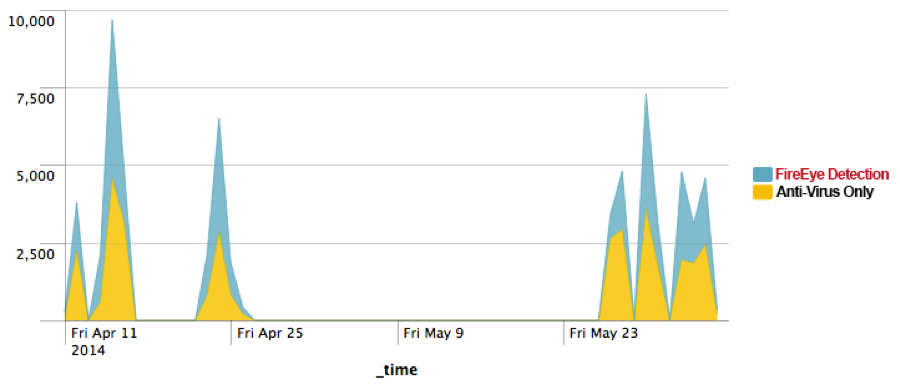
These malicious email campaign spikes revealed that FireEye appliances, with the support of DTI cloud, were able to provide a full picture of the campaign (blue), while only a fraction of the emailed malware samples could be detected by various Anti-Virus vendors (yellow).

fig7

Figure 7 FireEye Detection vs. Anti-Virus Detection

By the end of May, we observed a big spike on the unique binaries associated with this malicious activity. Compared to the previous days where malware authors used just 10-40 unique MD5s or less per day, we saw about 6400 unique MD5s sent out on May 29th. That is a 16,000% increase in unique MD5s over the usual malicious email campaign we’d observed. Compared to other recent email campaigns, Asprox uses a volume of unique samples for its campaign.

fig8

Figure 8 Asprox Campaign Unique Sample Tracking

fig9

Figure 9 Geographical Distribution of the Campaign

fig10

Figure 10 Distribution of Industries Affected

Brief Technical Analysis

fig11

Figure 11 Attack Architecture

Infiltration

The infiltration phase consists of the victim receiving a phishing email with a zipped attachment containing the malware payload disguised as an Office document. Figure 11 is an example of one of the more recent phishing attempts.

fig12

Figure 12 Malware Payload Icon

Evasion

Once the victim executes the malicious payload, it begins to start an svchost.exe process and then injects its code into the newly created process. Once loaded into memory, the injected code is then unpacked as a DLL. Notice that Asprox uses a hardcoded mutex that can be found in its strings.

  1. Typical Mutex Generation
    1. “2GVWNQJz1″
  2. Create svchost.exe process
  3. Code injection into svchost.exe

Entrenchment

Once the dll is running in memory it then creates a copy of itself in the following location:

%LOCALAPPDATA%/[8 CHARACTERS].EXE

Example filename:

%LOCALAPPDATA%\lwftkkea.exe

It’s important to note that the process will first check itself in the startup registry key, so a compromised endpoint will have the following registry populated with the executable:

HKCU\Software\Microsoft\Windows\CurrentVersion\Run

Exfiltration/Communication

The malware uses various encryption techniques to communicate with the command and control (C2) nodes. The communication uses an RSA (i.e. PROV_RSA_FULL) encrypted SSL session using the Microsoft Base Cryptographic Provider while the payloads themselves are RC4 encrypted. Each sample uses a default hardcoded public key shown below.

Default Public Key

—-BEGIN PUBLIC KEY—-

MIGfMA0GCSqGSIb3DQEBAQUAA4GNADCBiQKBgQDCUAUdLJ1rmxx+bAndp+Cz6+5I’

Kmgap2hn2df/UiVglAvvg2US9qbk65ixqw3dGN/9O9B30q5RD+xtZ6gl4ChBquqw

jwxzGTVqJeexn5RHjtFR9lmJMYIwzoc/kMG8e6C/GaS2FCgY8oBpcESVyT2woV7U

00SNFZ88nyVv33z9+wIDAQAB

—-END PUBLIC KEY—-

First Communication Packet

Bot ID RC4 Encrypted URL

POST /5DBA62A2529A51B506D197253469FA745E7634B4FC

HTTP/1.1

Accept: */*

Content-Type: application/x-www-form-urlencoded

User-Agent: <host useragent>

Host: <host ip>:443

Content-Length: 319

Cache-Control: no-cache

<knock><id>5DBA62A247BC1F72B98B545736DEA65A</id><group>0206s</group><src>3</src><transport>0</transport><time>1881051166</time><version>1537</version><status>0</status><debug>none<debug></knock>

C2 Commands

In comparison to the campaign at the end of 2013, the current campaign uses one of the newer versions of the Asprox family where threat actors added the command “ear.”

if ( wcsicmp(Str1, L”idl”) )

{

if ( wcsicmp(Str1, L”run”) )

{

if ( wcsicmp(Str1, L”rem”) )

{

if ( wcsicmp(Str1, L”ear”)

{

if ( wcsicmp(Str1, L”rdl”) )

{

if ( wcsicmp(Str1, L”red”) )

{

if ( !wcsicmp(Str1, L”upd”) )

C2 commands Description
idl This commands idles the process to wait for commands
run Download from a partner site and execute from a specified path
rem Remove itself
ear Download another executable and create autorun entry
rdl Download, inject into svchost, and run
upd Download and update
red Modify the registry

C2 Campaign Characteristics

fig13

For the two major malicious email campaign spikes in April and May of 2014, separate sets of C2 nodes were used for each major spike.

April

May-June

94.23.24.58 192.69.192.178
94.23.43.184 213.21.158.141
1.234.53.27 213.251.150.3
84.124.94.52 27.54.87.235
133.242.134.76 61.19.32.24
173.45.78.226 69.64.56.232
37.59.9.98 72.167.15.89
188.93.74.192 84.234.71.214
187.16.250.214 89.22.96.113
85.214.220.78 89.232.63.147
91.121.20.71
91.212.253.253
91.228.77.15

Conclusion

The data reveals that each of the Asprox botnet’s malicious email campaigns changes its method of luring victims and C2 domains, as well as the technical details on monthly intervals. And, with each new improvement, it becomes more difficult for traditional security methods to detect certain types of malware.

Acknowledgements:

Nart Villeneuve, Jessa dela Torre, and David Sancho. Asprox Reborn. Trend Micro. 2013. http://www.trendmicro.com/cloud-content/us/pdfs/security-intelligence/white-papers/wp-asprox-reborn.pdf

Molerats, Here for Spring!

Between 29 April and 27 May, FireEye Labs identified several new Molerats attacks targeting at least one major U.S. financial institution and multiple, European government organizations.

When we last published details relevant to Molerats activity in August of 2013, we covered a large campaign of Poison Ivy (PIVY) attacks directed against several targets in the Middle East and the United States. We felt it was significant to highlight the previous PIVY campaigns to:

  1. Demonstrate that any large-scale, targeted attacks utilizing this off-the-shelf Remote Access Tool (RAT) shouldn’t be automatically linked to Chinese threat actors.
  2. Share several documented tactics, techniques, and procedures (TTP), and indicators of compromise (IOC) for identifying Molerats activity.

However, this was just one unique facet to a much broader series of related attacks dating back to as early as October 2011 and are still ongoing. Previous research has linked these campaigns to Molerats, but with so much public attention focused on APT threat actors based in China, it’s easy to lose track of targeted attacks carried out by other threat actor groups based elsewhere. For example, we recently published the “Operation Saffron Rose” whitepaper, detailing a rapidly evolving Iranian-based threat actor group known as the “Ajax Security Team.”

New Attacks, Same Old Tactics

With the reuse of command and control (CnC) infrastructure and a similar set of TTPs, molerats1Molerats activity has been tracked and expanded to a growing target list, which includes:

  • Palestinian and Israeli surveillance targets
  • Government departments in Israel, Turkey, Slovenia, Macedonia, New Zealand, Latvia, the U.S., and the UK
  • The Office of the Quartet Representative
  • The British Broadcasting Corporation (BBC)
  • A major U.S. financial institution
  • Multiple European government organizations

Previous Molerats campaigns have used several garden-variety, freely available backdoors such as CyberGate and Bifrost, but, most recently, we have observed them making use of the PIVY and Xtreme RATs. Previous campaigns made use of at least one of three observed forged Microsoft certificates, allowing security researchers to accurately tie together separate attacks even if the attacks used different backdoors. There also appears to be a habitual use of lures or decoy documents – in either English or Arabic-language – with content focusing on active conflicts in the Middle East. The lures come packaged with malicious files that drop the Molerats’ flavor of the week, which happen to all be Xtreme RAT binaries in these most recent campaigns.

Groundhog Day

On 27 May we observed at least one victim downloading a malicious .ZIP file as the result of clicking on a shortened Google URL – http://goo[.]gl[/]AMD3yX – likely contained inside of a targeted spearphishing email. However, we were unable to confirm for this particular victim:

molerats2

1) “حصري بالصور لحظة الإعتداء على المشير عبد الفتاح السيسي.scr” 
(MD5: a6a839438d35f503dfebc6c5eec4330e)

  • Malicious download URL was sent to a well-known European government organization.
  • The shortened URL breaks out to “http://lovegame[.]us/ Photos[.]zip,” which was clicked/downloaded by the victim.
  • The extracted binary, “حصري بالصور لحظة الإعتداء على المشير عبد الفتاح السيسي.scr,” opens up a decoy Word document and installs/executes the Xtreme RAT binary into a temp directory, “Documents and Settings\admin\Local Settings\Temp\Chrome.exe.”
  • The decoy document, “rotab.doc,” contains three images (a political cartoon and two edited photos), all negatively depicting former military chief Abdel Fattah el-Sisi.
  • Xtreme RAT binary dropped: “Chrome.exe” (MD5: a90225a88ee974453b93ee7f0d93b104), which is unsigned.
  • As of 29 May, the URL has been clicked 225 times by a variety of platforms and browser types, so the campaign was likely not limited to just one victim.
  • Two of the download referrers are webmail providers (EIM.ae” and “Sltnet.lk”) further indicating the malicious URL was likely disseminated via spearphishing emails.

On 29 April we observed two unique malicious attachments being sent to two different victims via spearphishing emails:

2) 8ca915ab1d69a7007237eb83ae37eae5moleratssss

  • Malicious file sent to both the financial institution and Ministry of Foreign Affairs targets.
  • Drops an Arabic language decoy document titled “Sisi.doc”, which appears to contain several copy/pasted excerpts of (now retired) Egyptian Major General Hossam Sweilem, discussing military strategy and the Muslim Brotherhood.
  • The title of the document appears to have several Chinese characters, yet the entire body of the document is written in Arabic. As noted in our August 2013 blog post, this could possibly be a poor attempt to frame China-based threat actors for these attacks.
  • Xtreme RAT binary dropped: “sky.exe” (MD5: 2d843b8452b5e48acbbe869e51337993), which is unsigned.

molerats4

3) “Too soon to embrace Sisi _ Egypt is an unpredictable place.scr” (MD5: 7f9c06cd950239841378f74bbacbef60)

  • Malicious file only sent to a European government organization.
  • Drops an English language decoy document also titled “Sisi.doc”, however this one appears to be an exact copy of a 23 April Financial Times’ news article about the uncertainties surrounding former military chief Abdel Fattah el-Sisi running for president in the upcoming Egyptian elections.
  • Drops the same Xtreme RAT binary: “sky.exe” (MD5: 2d843b8452b5e48acbbe869e51337993), which is unsigned.

Another attribute regularly exhibited by Molerats malware samples are that they are often archived inside of self-extracting RAR files and encoded with EXECryptor V2.2, along with several other legitimate looking archived files.

Related Samples

Both of the malicious files above have a compile date/time of 2014-04-17 09:43:29-0000, and, based on this information, we were able to identify five additional samples (one sample only contained a lure but no malicious binary), related to the 29 April attacks. These samples were a little more interesting, because they contained an array of either attempted forged or self-signed Authenticode certificates.

All of the additionally identified samples were sent to one of the same European government organizations mentioned previously.

4) 2b0f8a8d8249402be0d83aedd9073662molerats5

  • Drops an Arabic language Word Document titled “list.doc”.
  • The title of the document appears to have several Chinese characters, yet the entire body of the document is written in Arabic.
  • Xtreme RAT binary dropped: “Download.exe” (MD5: cff48ff88c81795ee8cebdc3306605d0). This malware is signed with a self-signed certificate issued by “FireZilla” (see below).Certificate serial number: {75 dd 9b 14 c6 6e 20 0b 2e 22 95 3a 62 7b 39 19}.

moleratsfirezille

Forged FireZilla certificate

5) 4f170683ae19b5eabcc54a578f2b530bmolerats8

  • Drops an Arabic language Word Document titled “points.doc,” which appears to be an online clipping from a news article about ongoing Palestinian reconciliation meetings between Fatah and Hamas in the Gaza strip.
  • The title of the document appears to have several Chinese characters, yet the entire body of the document is written in Arabic.
  • Xtreme RAT binary dropped: “VBB.exe” (MD5: 6f9585c8748cd0e7103eab4eda233666). Though the malware appeared to be signed with a certificate named “Kaspersky Lab”, the real hash did not match the signed hash (see below).Certificate serial number: {a7 ed a5 a2 15 c0 d1 91 32 9a 1c a4 b0 53 eb 18}.

kaspersky

(Forged Kaspersky Lab certificate)

6) 793b7340b7c713e79518776f5710e9dd & a75281ee9c7c365a776ce8d2b11d28daredtext

  • Both drop an Arabic language Word Document titled “qatar.doc,” which appears to be an online clipping for a new article concerning members of the Gulf Cooperation Council (GCC) and the ongoing conflicts between Saudi Arabia, the United Arab Emirates (UAE), and Bahrain – all against Qatar because of the country’s support for the Muslim Brotherhood.
  • The title of the document appears to have several Chinese characters, yet the entire body of the document is written in Arabic.
  • Xtreme RAT binary dropped by the first sample: “AVG.exe” (MD5: a51da465920589253bf32c6115072909), which is unsigned.

7) Pivoting off one of the fake Authenticode certificates we were able to identify at least one additional related binary, “vmware.exe” (MD5: 6be46a719b962792fd8f453914a87d3e), also Xtreme RAT, but doesn’t appear to have been sent to any of our customers. The malicious binary is also encoded with EXECryptor V2.2–similar to the samples above–and the CnC domain has resolved to IPs that overlap with previously identified Molerats malware.

Indicators of Compromise

molerats11

Although the samples above are all Xtreme RAT, all but two samples communicate over different TCP ports. The port 443 callback listed in the last sample is also not using actual SSL, but instead, the sample transmits communications in clear-text – a common tactic employed by adversaries to try and bypass firewall/proxy rules applying to communications over traditional web ports. These tactics, among several others mentioned previously, seem to indicate that Molerats are not only aware of security researchers’ efforts in trying to track them but are also attempting to avoid using any obvious, repeating patterns that could be used to more easily track endpoints infected with their malware.

Conclusion

Although a large number of attacks against our customers appear to originate from China, we are tracking lesser-known actors also targeting the same firms. Molerats campaigns seem to be limited to only using freely available malware; however, their growing list of targets and increasingly evolving techniques in subsequent campaigns are certainly noteworthy.

MD5 Samples

  • a6a839438d35f503dfebc6c5eec4330e
  • 7f9c06cd950239841378f74bbacbef60
  • 8ca915ab1d69a7007237eb83ae37eae5
  • 2b0f8a8d8249402be0d83aedd9073662
  • 4f170683ae19b5eabcc54a578f2b530b
  • 793b7340b7c713e79518776f5710e9dd
  • a75281ee9c7c365a776ce8d2b11d28da
  • 6be46a719b962792fd8f453914a87d3e

Older Molerats samples from Dec 2013 (not listed above)

  • 34c5e6b2a988076035e47d1f74319e86
  • 13e351c327579fee7c2b975b17ef377c
  • c0488b48d6aabe828a76ae427bd36cf1
  • 14d83f01ecf644dc29302b95542c9d35

References & Credits

A special thanks to Ned Moran and Matt Briggs of FireEye Labs for supporting this research.