A little more on Donbot…

Donbot
is primarily a spam bot, one of the few spam botnets whose growth was
not hampered by the McColo shutdown earlier this year.  As a matter of fact, the sudden
shut down of big spammers like Srizbi and Rustock helped Donbot climb the
spam botnet rankings.  In this article I am going discuss different aspects of Donbot, first as a malware and then in the
later half I will try to shed some light on its command and control architecture.

Lets start with a particular donbot sample (273a07dccdfff421bfde652912f02e32).  Like its peer botnets (Ozdok, Xarvester etc), Donbot is also a template based spam bot.  Everything from the subject line to the mailing list, the message body, and the User Agents to be used in the SMTP headers are retrieved from the CnC server. 

Template

Continue reading »

Gumblar… Not Gumby!

Ok, I admit this blog post is not about our childhood TV friend, Gumby… Instead it's about a much more sinister character, Gumblar & its malware henchmen…

Originally making its debut back in March/April of this year (see here , here  and here) and then suddenly it went quiet for a few months, until recently… Yes, Gumblar is back with a vengeance & still causing problems for it's unsuspecting victims.

The primary delivery mechanism is still via Drive-By-Download (notably compromised sites serving malicious Adobe PDF's) which when successful will load the malware onto your system.

We have taken a look at a couple of the Gumblar associated malware samples, you can see some VirusTotal results here & here.

Continue reading »

A leap into the unknown - Part 1

A leap into the unknown is a series which will discuss some lesser known malware, that has a reasonably good command and control structure.  Most of this malware might not be totally new to the AVs, but they were never considered for more than just creating a signature.  Little or no effort has been made to disclose the motivation behind creating this malware, the CnC architecture, or the people behind it.  These articles are not to prove that "My (discovered) botnet is bigger than yours".  No offense to those who may already know about this malware and might not agree with the word 'unknown' in the title of this article. There is always someone who knows more than you do.

Continue reading »

Killing the beast…Part 3

In the third part of this series, I'm going to discuss the command and control structure of another famous botnet, Clampi a.k.a ilomo. Clampi is all about data stealing and is famous for its anti-reversing and evasion techniques. The financial damage this information stealer can cause is evident from the fact that it has recently been publicly disclosed of a cyber theft of more than $150,000.  Notorious isn't it..?

Like the first two parts where I discussed the command and control structure of the Pushdo and Koobface botnets, I'll start by showing the current geographical distribution of Clampi CnCs, followed by a brief analysis on the chances of shutting down these control servers and hence the complete botnet.

Continue reading »

Who is Exploiting the Adobe Flash 0-day? - Part 2

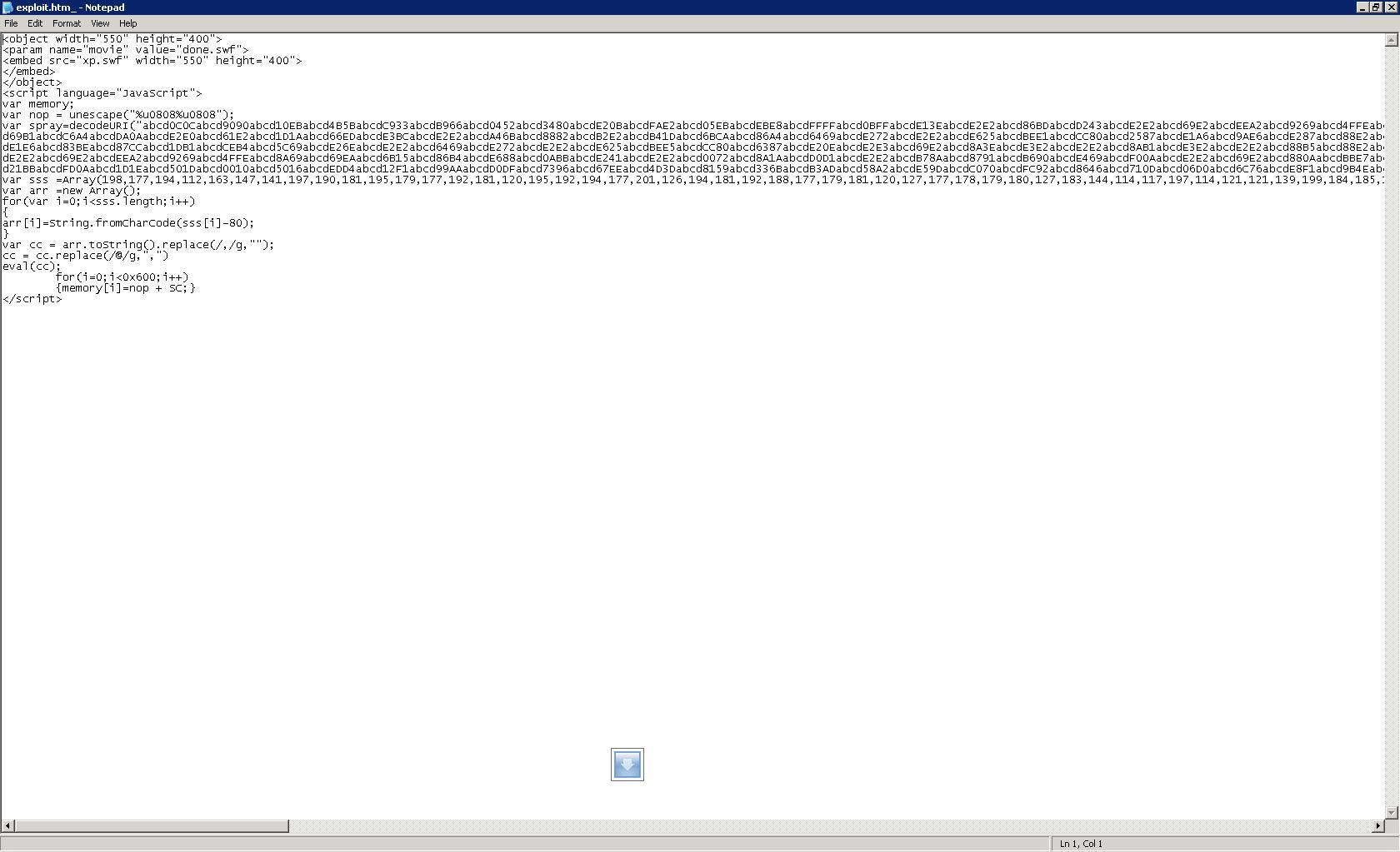
The new Flash 0-day has opened multiple avenues for malware authors. In my last article I showed how this vulnerability is being exploited via the PDF reader's support for SWF files.  However, this vulnerability can just as easily be exploited in a standard drive-by fashion purely in Flash as well.  This is precisely what has started to happen.

Here is the snippet of the javascript which is actively targeting this 0-day vulnerability.

Exploit

Continue reading »

Who is Exploiting the Adobe Flash 0-day?

It looks like Zero-day discoveries for the month of July are not quite over yet. I have already talked about two vulnerabilities inside MS products earlier this month:

July 7th 2009:   Who is Exploiting the Windows 0-day (MSVIDCTL.DLL) ?
July 14th 2009: Who is Exploiting the Office Web Components 0-day?

Then came the 3rd one inside Mozilla FireFox 3.5, almost at the exact same time.  Sadly enough, this article is about another 0-day (fourth in a row) which has recently been discovered in the Adobe Flash player.  As of today, this vulnerability is unpatched and is currently being exploited in the wild. To make it even worse, this vulnerability may also be exploited via 'Adobe PDF Reader' by misusing its support for the SWF component.  According to Adobe, 'Adobe Reader' , 'Acrobat 9.1.2', and 'Adobe Flash Player 9 and 10' are vulnerable to this attack.

Who is trying to exploit this vulnerability?  To find this answer I ran one of the malicious pdf files (09a0f7aae0e22b5d80c7950890f3f738) inside my sandnet, running the Adobe Reader 9.1. As expected, in a few seconds I observed Adobe Reader crash after creating and executing a new file, SUCHOST.EXE (96cb88dfc54f765c30d44ba60117fa72).

Continue reading »

Heap Spraying with Actionscript

Why turning off Javascript won’t help this time


Introduction

As you may have heard, there’s a new Adobe PDF-or-Flash-or-something 0-day in the
wild. So this is a quick note about how it’s implemented, but this
blog post is not going to cover any details about the exploit itself
.


Background Summary

Most of the Acrobat exploits over the last several months use the, now
common, heap spraying
technique
, implemented in
Javascript/ECMAscript, a
Turing complete
language that Adobe thought would
go well with static documents. (Cause that went so well
for Postscript)
(Ironically, PDF has now come full circle back
to having the features of Postscript that it was
trying to get away from
.)
The exploit could be made far far less reliable, by
disabling Javascript in
your Adobe Acrobat Reader
.

But apparently there’s no easy way to disable Flash through the UI.
US-CERT recommends renaming the
%ProgramFiles%\Adobe\Reader 9.0\Reader\authplay.dll and
%ProgramFiles%\Adobe\Reader 9.0\Reader\rt3d.dll
files. [Edit: Actually the source for this advice is the Adobe Product Security Incident Response Team (PSIRT).]

Anyway, here’s why… Flash has it’s own version of ECMAScript called
Actionscript, and whoever wrote this new 0-day, finally did something new by
implementing the heap-spray routine with Actionscript inside of Flash.

Continue reading »

Bad Actors Part 7 - 3fn (Or: Cutwail - How to do it right)

“Wait … *beep beep* back up for a
second, Alex.  I heard 3fn was brought down
by the FTC!” 

That would be correct!  On June 4th the FTC served a
takedown notice that essentially dropped 3fn (aka “Triple Fiber Network”, Pricewert,
APX Telecom, APS Communications) off the Internet.  I was approached by law enforcement looking
for evidence of malicious activities, and luckily, I was in the midst of
writing up an article for my Bad Actors blog series.  I decided to wait until a little time had
passed before publishing details as not to tip off 3fn and possibly ruin an
investigation.  (Note that the investigatory
group that approached me was at the federal level, but was not the FTC)

Below you’ll find my analysis of their
IP blocks and a large amount of data about the Bad Actors whom they supported.  Most of the links below are completely Not
Safe For Work, possibly malicious, and frankly, many of them are disgusting in name as well as content.  It’s not advised that you actually visit any of them.  I also have more content that I didn't post, and if you're interested in it, feel free to drop me a line.

Continue reading »

Who is Exploiting the Office Web Components 0-day?

Just a day before Patch Tuesday, when Microsoft is going to release couple of patches for DirectShow vulnerabilities including MSVIDCTRL 0-day , IE (Internet Explorer) users are hit by another surprise. A new 0-day vulnerability has been identified in MS office web component and is currently being exploited via the IE scripting interface. There is no patch available at the moment but MS has come up with a workaround.

One of the malicious URL which has been found to exploit this vulnerability is hxxp://www.fdsdffdfsf.cn/of.htm.

Continue reading »

DDOS Madness Continued…

The DDOS attacks which started around July 4th 2009 and paralyzed some important US and South Korean web sites have come to an end, but the madness behind these attacks is not quite finished yet.

The MYDOOM variant (msiexec1.exe: 0f394734c65d44915060b36a0b1a972d) which initially downloaded a DDOS component has recently been seen to download another component (wversion.exe: f5c6b935e47b6a8da4c5337f8dc84f76) whose sole purpose is to permanently damage the infected systems hard drives. This hard drive killer component acts like a time bomb which will start triggering from July 10th onwards. Sadly it means that today, on July 11th, all those infected pcs which were up and running yesterday are already damaged.

Continue reading »