Jump to content

FireEye Malware

Intelligence Lab

Threat research, analysis, and mitigation

12 posts categorized "Zero-day"

Happy New Year from New Java Zero-Day

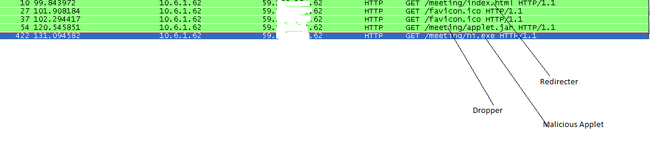
We observed that a Java security bypass zero-day vulnerability (CVE-2013-0422) has been actively exploited in the wild starting Jan. 2. We have been able to reproduce the attack in-house with the latest Java 7 update (Java 7 update 10) on Windows.

We initially wanted to hold off on posting this blog entry until we received confirmation from Oracle; however, since other researchers are starting to blog on this issue, we have decided to release our summary. We will continue our research and continue to share more information.

Continue reading "Happy New Year from New Java Zero-Day " »

CFR Watering Hole Attack Details

[Updated on December 30, 2012] On December 27, we received reports that the Council on Foreign Relations (CFR) website was compromised and hosting malicious content on or around 2:00 PM EST on Wednesday, December 26. Through our Malware Protection Cloud, we can confirm that the website was compromised at that time, but we can also confirm that the CFR website was also hosting the malicious content as early as Friday, December 21—right before a major U.S. holiday.

Continue reading "CFR Watering Hole Attack Details" »

Java Zero-Day - First Outbreak

A few days ago I talked about the existence of a new java zero-day flaw (CVE-2012-4681). Soon after the publication of my blog, the white-hats kicked in and there was Proof Of Concept (POC) code ready overnight. At this point, a major outbreak was inevitable. We soon came to know that the master mind behind the Blackhole exploit kit has plans to add this zero-day to his package. This morning we started getting the first indication of a large scale attack. So far we have observed over a dozen domains actively attacking systems with this exploit, and the count is increasing rapidly. After seeing the reliability of this attack, I have no doubt in my mind that within hours the casualties will be in the thousands.

Continue reading "Java Zero-Day - First Outbreak" »

Zero-Day Season is Not Over Yet

New Java zero-day vulnerability has been spotted in the wild. We have seen this unpatched exploit being used in limited targeted attacks. Most of the recent Java run-time environments i.e., JRE 1.7x are vulnerable. In my lab environment, I was able to successfully exploit my test machine against latest version of FireFox with JRE version 1.7 update 6 installed.


Exploit

Continue reading "Zero-Day Season is Not Over Yet" »

Stories About Botnets - Part 2

In the first part of this series, I talked about a few botnets that are using random domain generation algorithms in order to conceal their Command and Control (CnC) servers. But that's not the only type of evasion being used by advanced malware. There are other types of polymorphism as well.

Some of the polymorphic strains found in these malware are as follows:

  1. Random domain generation (as I talked about in Part 1)
  2. Random URL and HTTP header generation
  3. Custom obfuscated protocols
  4. Disguised as legitimate objects like a gif or jpeg image file, etc.

Today, I would like to talk about type 2—botnets that are good at randomizing their HTTP communication. Readers will see shortly how intelligently these malware are bypassing signature-based defenses.

Continue reading "Stories About Botnets - Part 2" »

Stories About Botnets - Part 1

The malware threat landscape is changing very fast. New and improved malware are hitting the attack surface on a daily basis. No wonder advanced malware like to operate in stealth mode. They try to change their behaviors, shapes and patterns as much as they can do to fool their enemies. Not only do we need a signature-less technology to handle such malware, but we also need a news resource continuously talking about these emerging threats, and this is where a series of blogs on this topic comes into play.

For the first of these series, I am going to talk about four different botnets that have recently been spotted randomizing their command and control domains. I will call these generically “New Botnet” A, B, C, and D so that we can focus on the details of the morphing behaviors. All of these botnets use custom algorithms to generate/locate their CnCs. The use of random CnC domains is not a new concept. In the past, we have seen Conficker, Srizbi, and Rustock using similar techniques, but in recent days we have seen more and more botnets adopting these stealth tactics.

Continue reading "Stories About Botnets - Part 1" »

Guest Blog: Former CIA CISO on Nation-State Security Challenges

There has been a growing realization by the global cyber security community that cybercriminals of all shapes, sizes, and motivations are getting a lot better at finding and exploiting zero-day attacks. Furthermore, while the bulk of these attacks still target the Microsoft family of operating systems, increasingly attacks are being targeted at the Unix/Linux family of operating systems. Correspondingly, there is also more recent awareness of the extent of Advanced Persistent Threat (APT) rootkits that were also previously unknown. So, many are asking what is the source of this very worrisome increase in sophisticated cyber attacks?

Continue reading "Guest Blog: Former CIA CISO on Nation-State Security Challenges" »

Even Hackers Don't Like to Work Weekends: Email Attack Trends from Q1 2012

In our second half (2H) of 2011 Advanced Threat Report, we provided compelling evidence that illustrated a possible correlation between an increase in email-based attacks and national holidays. Continuing this theme, let’s widen our dataset to worldwide and focus on the corresponding statistics collected year-to-date for 2012. To be clear, these statistics reflect the number of malicious attachments seen after initial SPAM and anti-virus filtering across our customer deployments who share intelligence back to us.

Figure 1. Rate of malicious attachments detected (worldwide) by relative volume (2H2011 + 2012YTD)

Continue reading "Even Hackers Don't Like to Work Weekends: Email Attack Trends from Q1 2012" »

Old Wine In A New Bottle

The recent Adobe Flash 0 Day (CVE-2011-2110) is a classic case of an old malware that has used new 0 days as a vector to spread itself. How and why I will explain shortly, first a little detail about the exploit itself. The exploit is targeting a vulnerability in the Action Script Virtual machine according to our good friends at Shadowserver. The swf file takes an info parameter and a successful exploitation leads to the download of a zlib compressed and xor encoded binary. The two GET requests in succession would look like this

Get_request_cve_2011_2110


Continue reading "Old Wine In A New Bottle" »

More on the IE 0-day - Hupigon Joins The Party

It was just a few days ago when Symantec disclosed a new 0-day vulnerability in Microsoft's Internet Explorer (versions 6, 7, and 8). They found at least one malware called 'Backdoor.Pirpi' that is actively exploiting this vulnerability in targeted email attacks posing as hotel reservation notifications. 

Here at FireEye labs, we have identified another type of Modern Malware called 'Hupigon' exploiting the same IE zero-day vulnerability. This malware looks to be more successful/reliable at infecting systems than Pirpi.

It is increasingly common that cyber criminals 'upgrade' Modern Malware with newly uncovered zero-day exploits. Now the question is, are the criminal masterminds behind this second wave of attacks the same as those behind the first wave?  In this article I will try to answer this question.

In order to find a link, let's compare these attacks side-by-side.

Continue reading "More on the IE 0-day - Hupigon Joins The Party" »