
Security Program Assessment Datasheet
Engage with Mandiant to evaluate your information security program and improve your security posture
Mandiant logs thousands of hours every year working with organizations of all sizes to remediate security breaches, identify vulnerabilities that targeted attackers exploit and provide guidance on closing the security gap. The Security Program Assessment draws on our collective expertise to deliver tailored, actionable recommendations to clients that improve your security posture and reduce risks.
What You Get
As part of the assessment you receive the following deliverables:
-
Executive threat briefing
A summary of findings and recommendations from the assessment will be delivered along with a threat intelligence report based on current attacker trends Mandiant analysts are observing in your industry.
-
Observations and gap analysis
Using the industry framework as a benchmark, the gap analysis identifies domains that need further development and provides a maturity plan aligned to each domain that will help strengthen your security posture.
-
Security program roadmap and recommendations
Receive a strategic and tactical action plan that provides recommendations on sequence and prioritization on improving effectiveness across one or more ten domain framework.
-
Threat detection report
Mandiant will correlate your company’s event logs against our propriety library of Indicators of Compromise (IOCs) to identify malicious activity. A detailed report will be provided that summarizes the findings and includes insights into threat actor profiles—if applicable.
Overview
Using industry standards as a starting point and incorporating our experience and knowledge gained from responding to hundreds of computer security incidents, we evaluate your program and provide recommendations across ten critical security domains. During the assessment, Mandiant consultants perform interviews, evidence collection, and artifact review along with facilitated workshops to ensure future improvements are driven through collaboration.
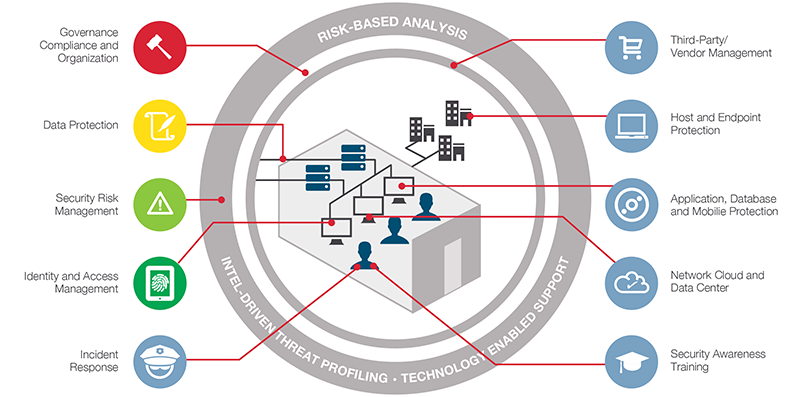
Strengthen your organization’s security posture by identifying areas of improvement within your infrastructure to protect information and reduce the impact of security incidents.
Security Program Assessment Process
As part of the process, Mandiant prioritizes the findings into
short- and long-term initiatives that will improve an organization’s
security posture over time, based on the perceived risk.
The recommendations provide guidance on how to fully utilize existing
tools as well as suggestions for new tools and processes that can be
implemented to improve the organization’s security posture and reduce risk.
Our Approach
Over the course of the assessment, we will provide an in-depth evaluation of your overall information security program’s effectiveness across ten distinct security domains. At the end of the engagement you receive a defined roadmap of short-, medium- and long-term improvement initiatives for your organization.

Step 1: Documentation collection and analysis
Mandiant experts will review existing polices, standards and procedures to gain an understanding of current operational capabilities and the technology and business environment.

Step 2: Interactive workshops and executive meetings
Based on information gathered, our experts will assess your organization’s maturity levels against best practices and industry standards. We will work with you to identify your organization’s goals and desired end state.

Step 3: Enterprise health check
Mandiant will review you organization security event data using proprietary technology and intelligence to assess whether attackers have evaded your current preventative security solutions and provides a Threat Detection report at the end of the evaluation.

Step 4: Recommendations and roadmap
We evaluate all the data collected during the assessment and provide recommendations and an implementation roadmap to achieve the organization’s desired short- and long-term goals.
Benefits
-
Reduce the impact of security incidents
Improve your ability to detect, respond to and resolve potential security incidents faster so you can minimize the impact. -
Build consensus on security improvements
Enhance internal collaboration and communication via knowledge sharing and prioritization of improvement initiatives. -
Reduce the risk of breaches and data theft
Ensure that your most sensitive data and assets are adequately protected. -
Prioritize budget and resources
Plan and allocate resources using a risk-based approach that maximizes the return on your security investments.
